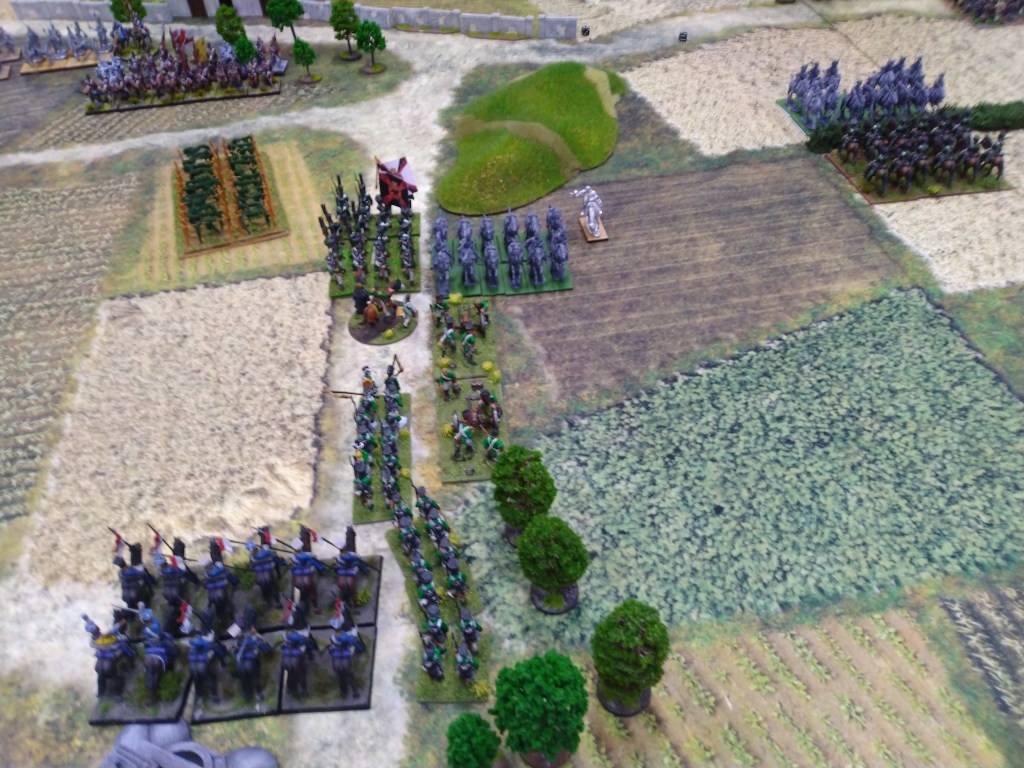
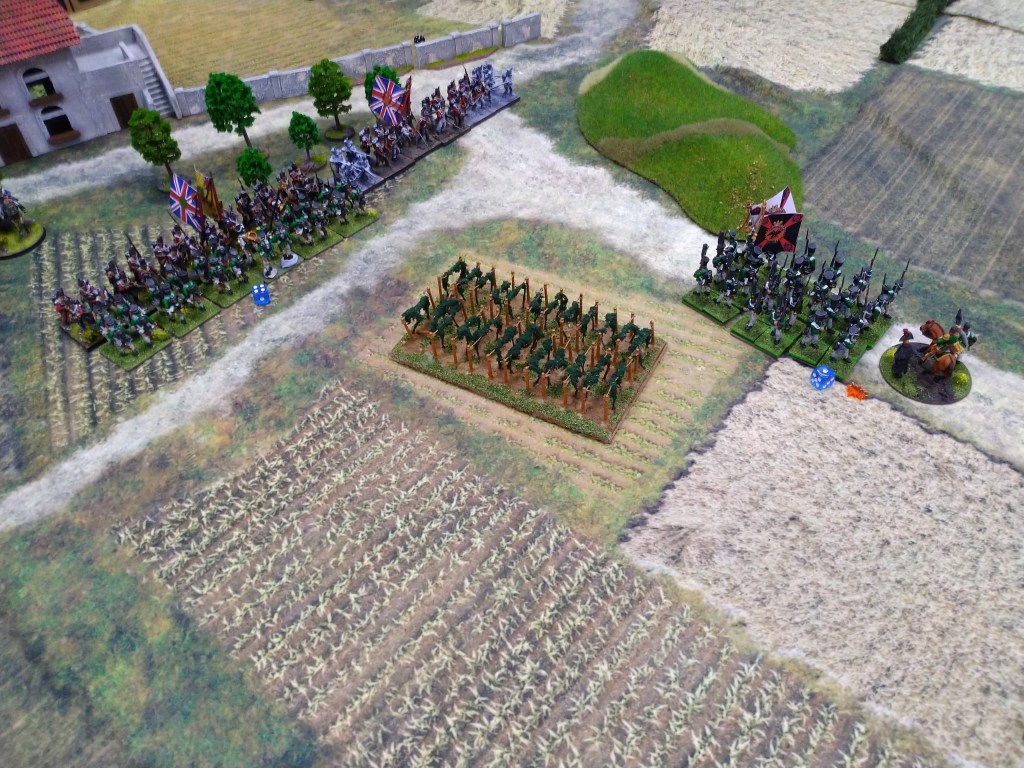
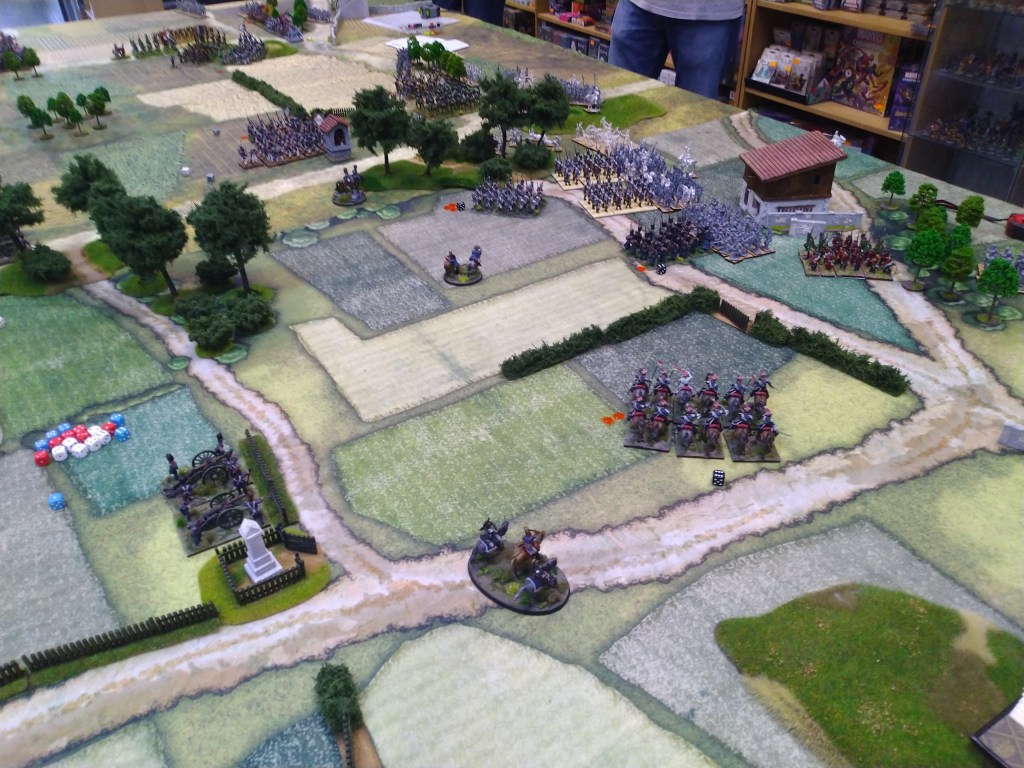
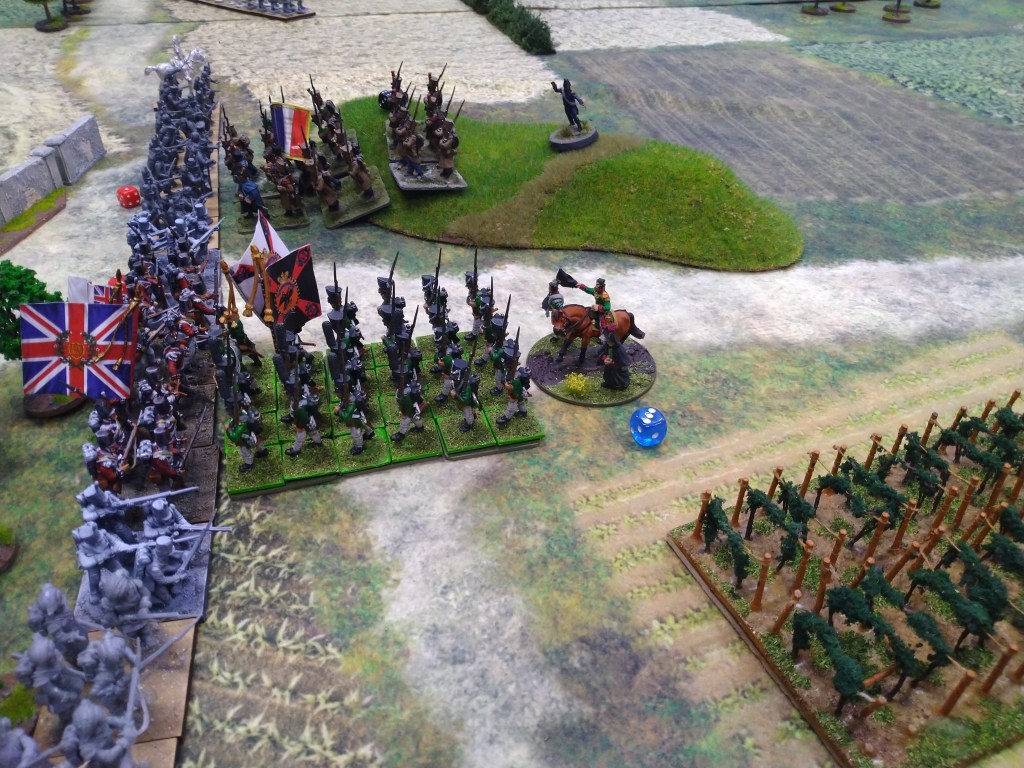
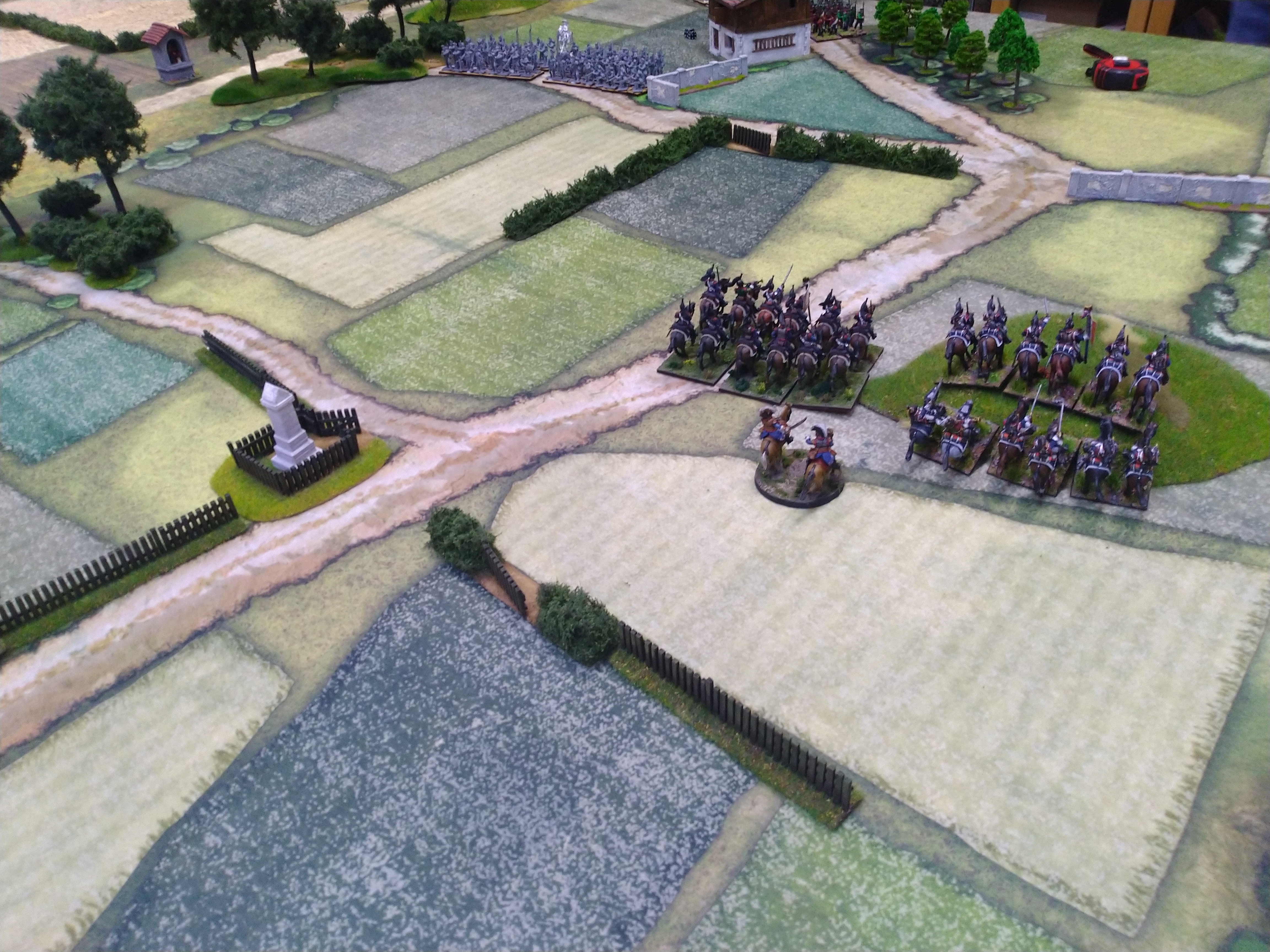
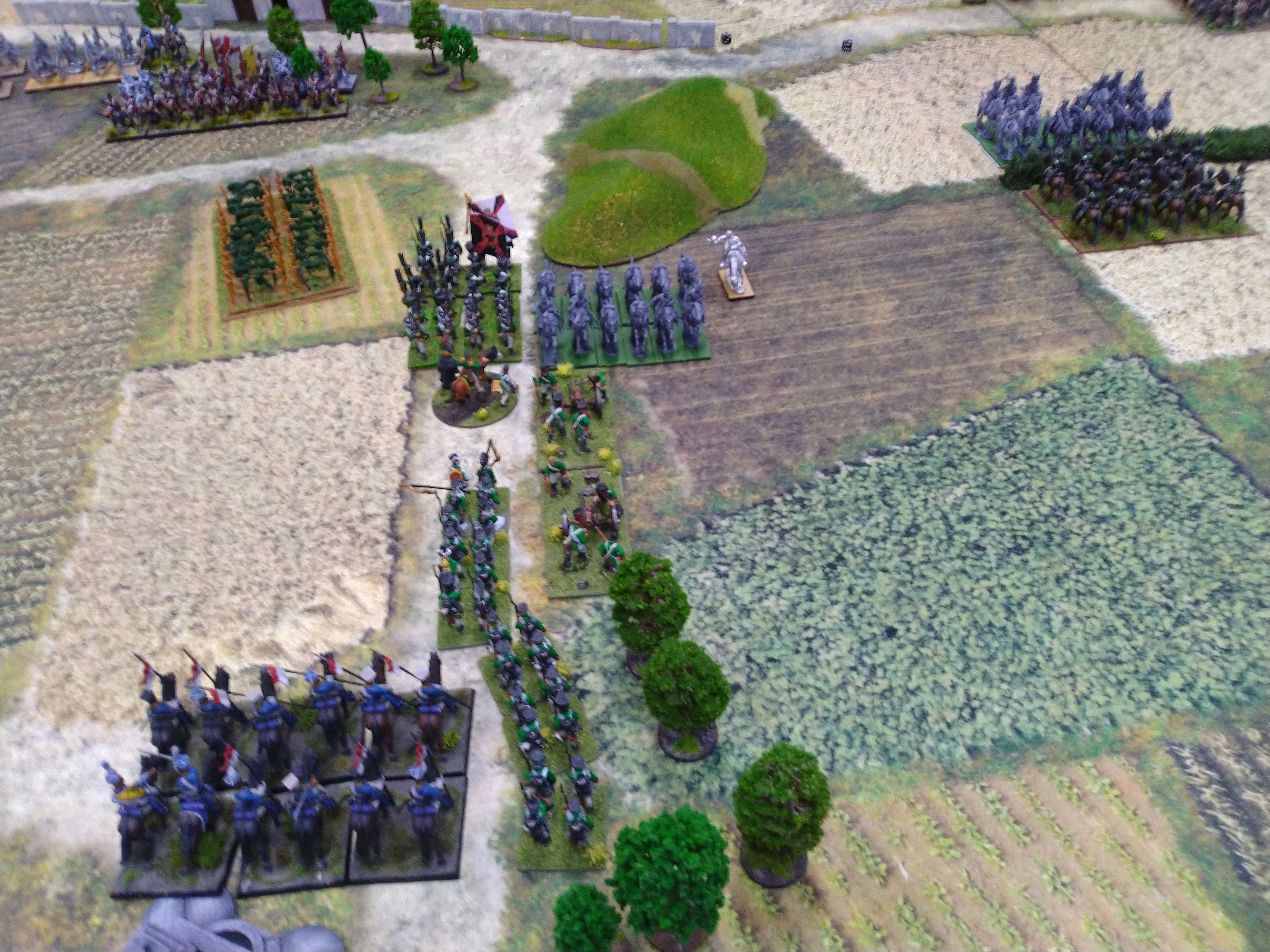
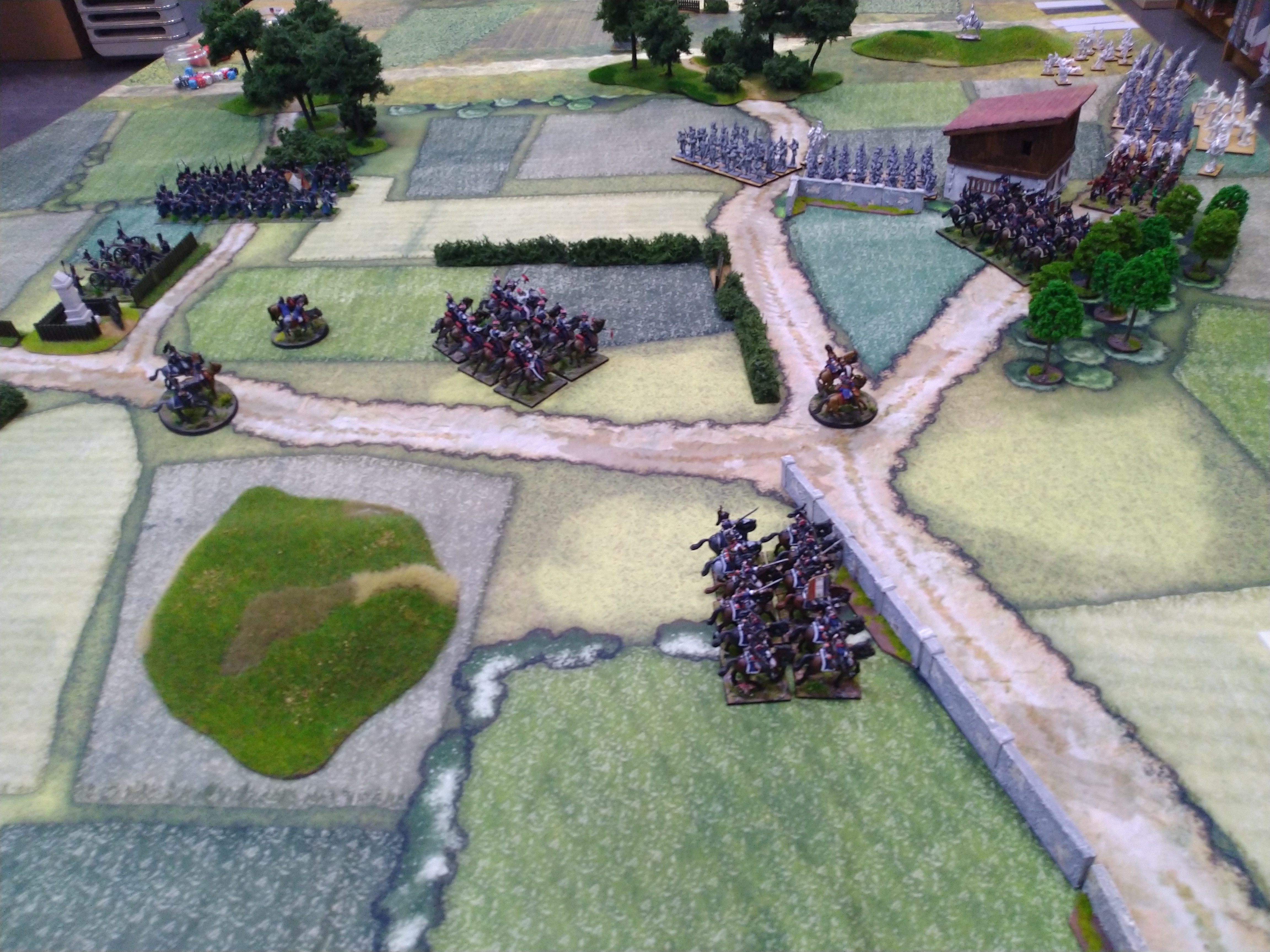
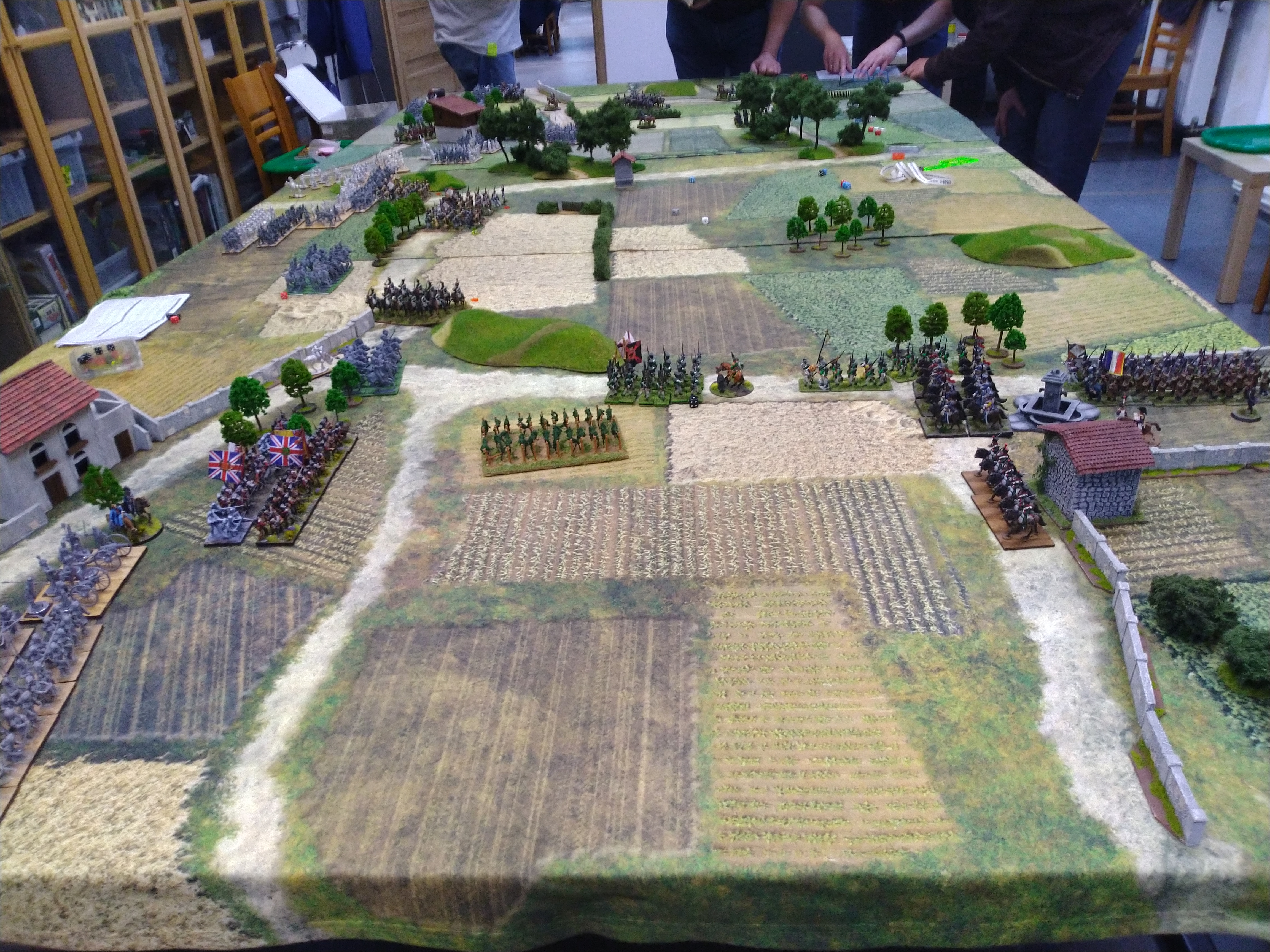
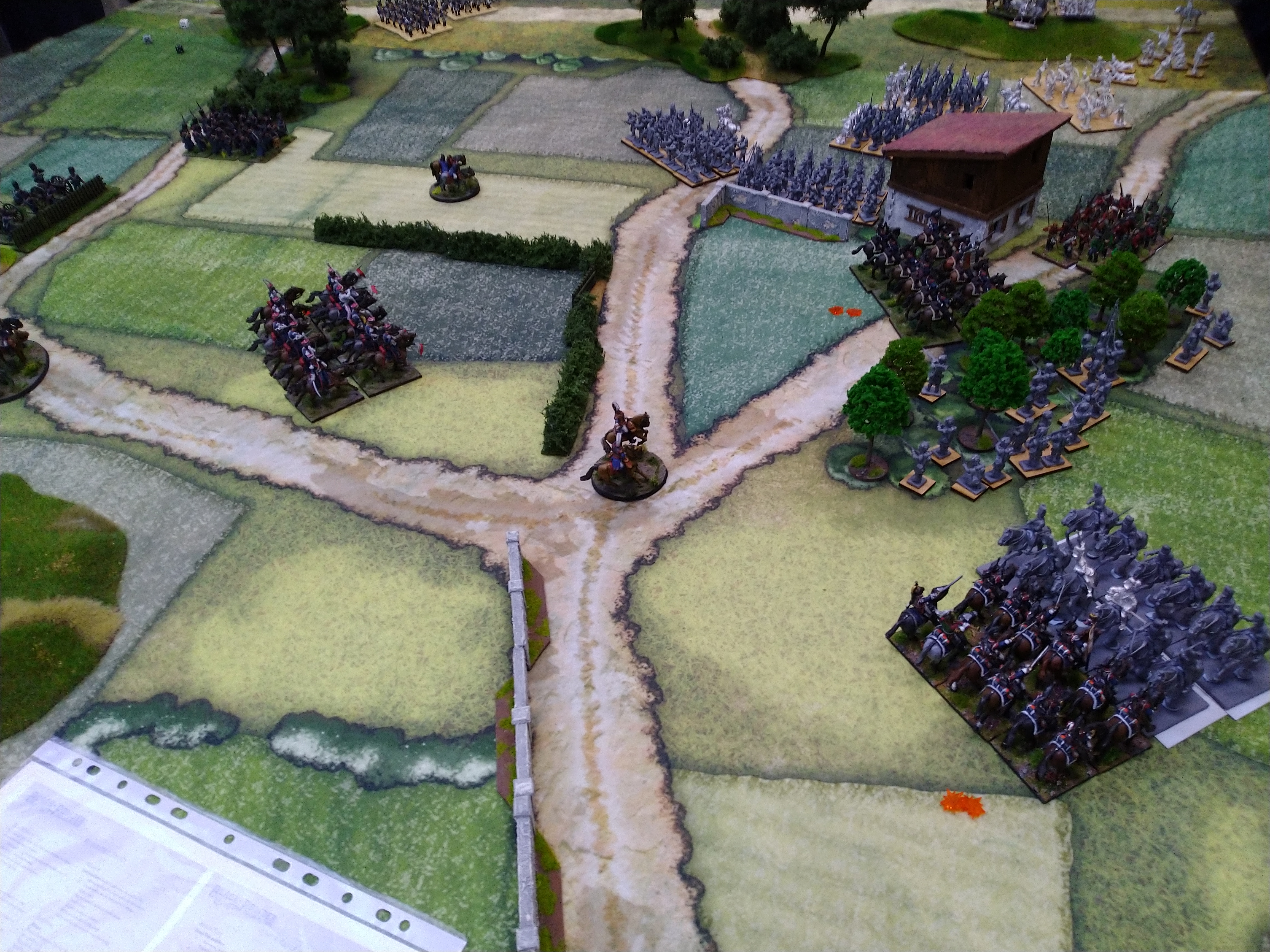
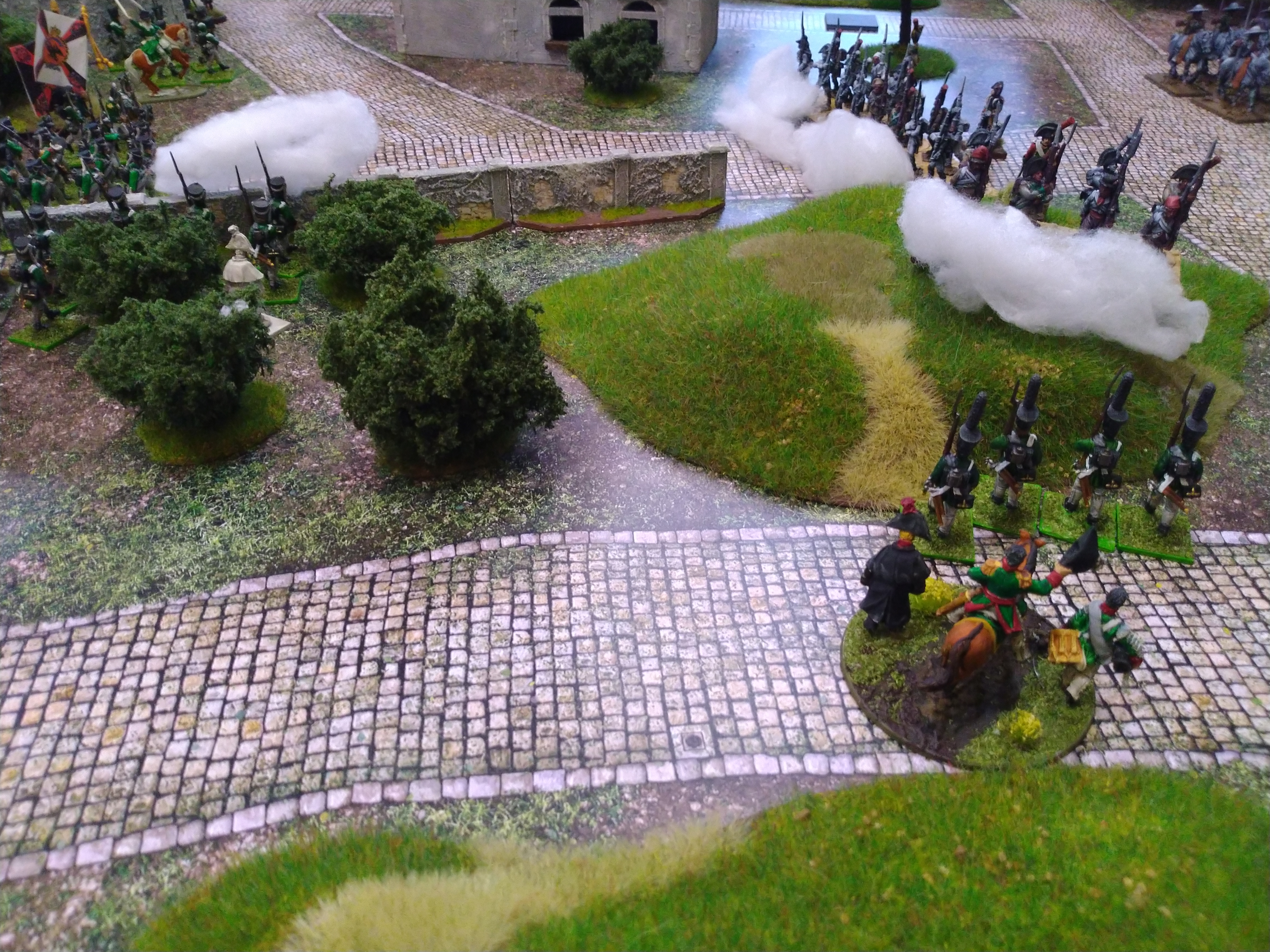
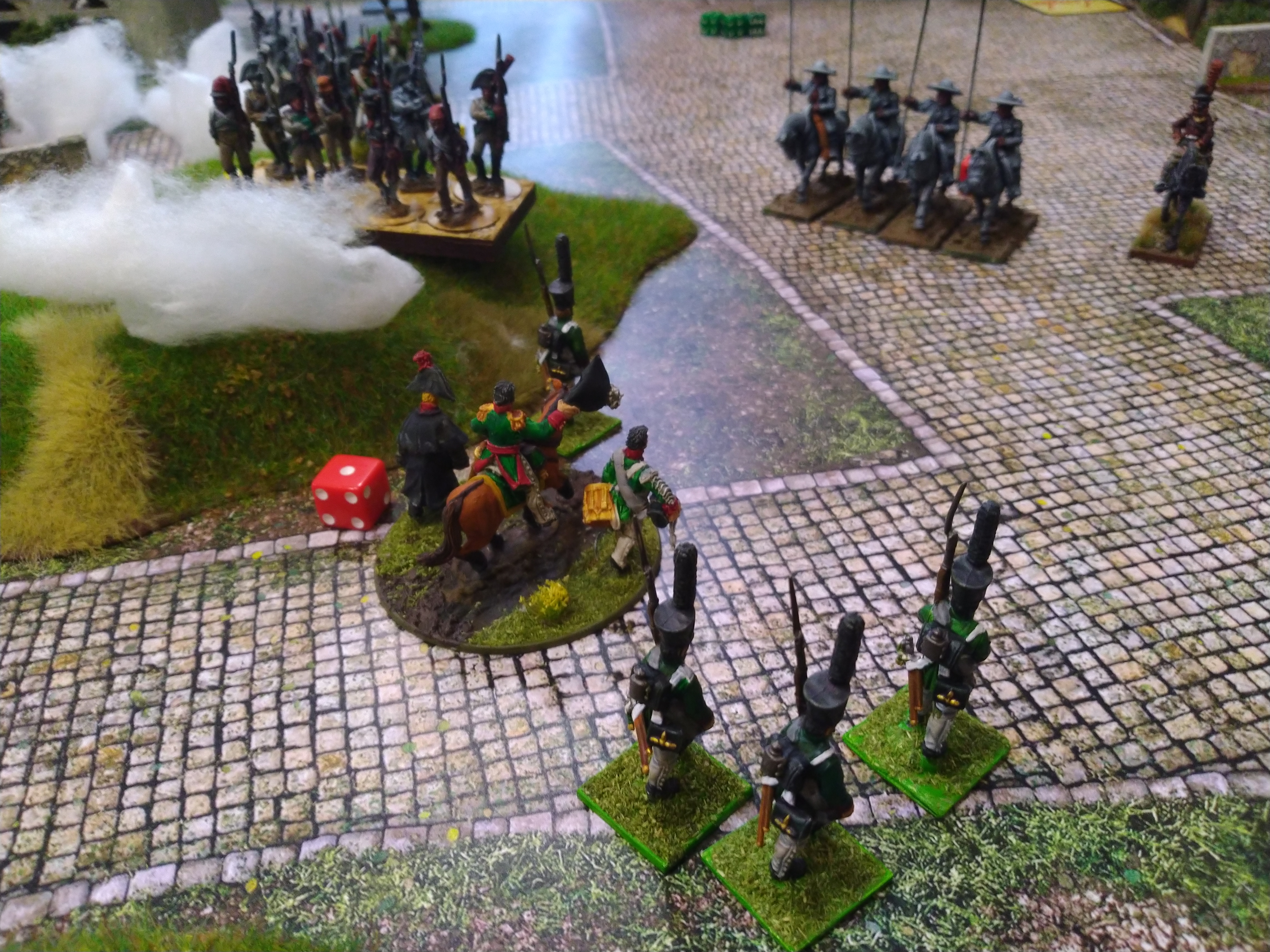
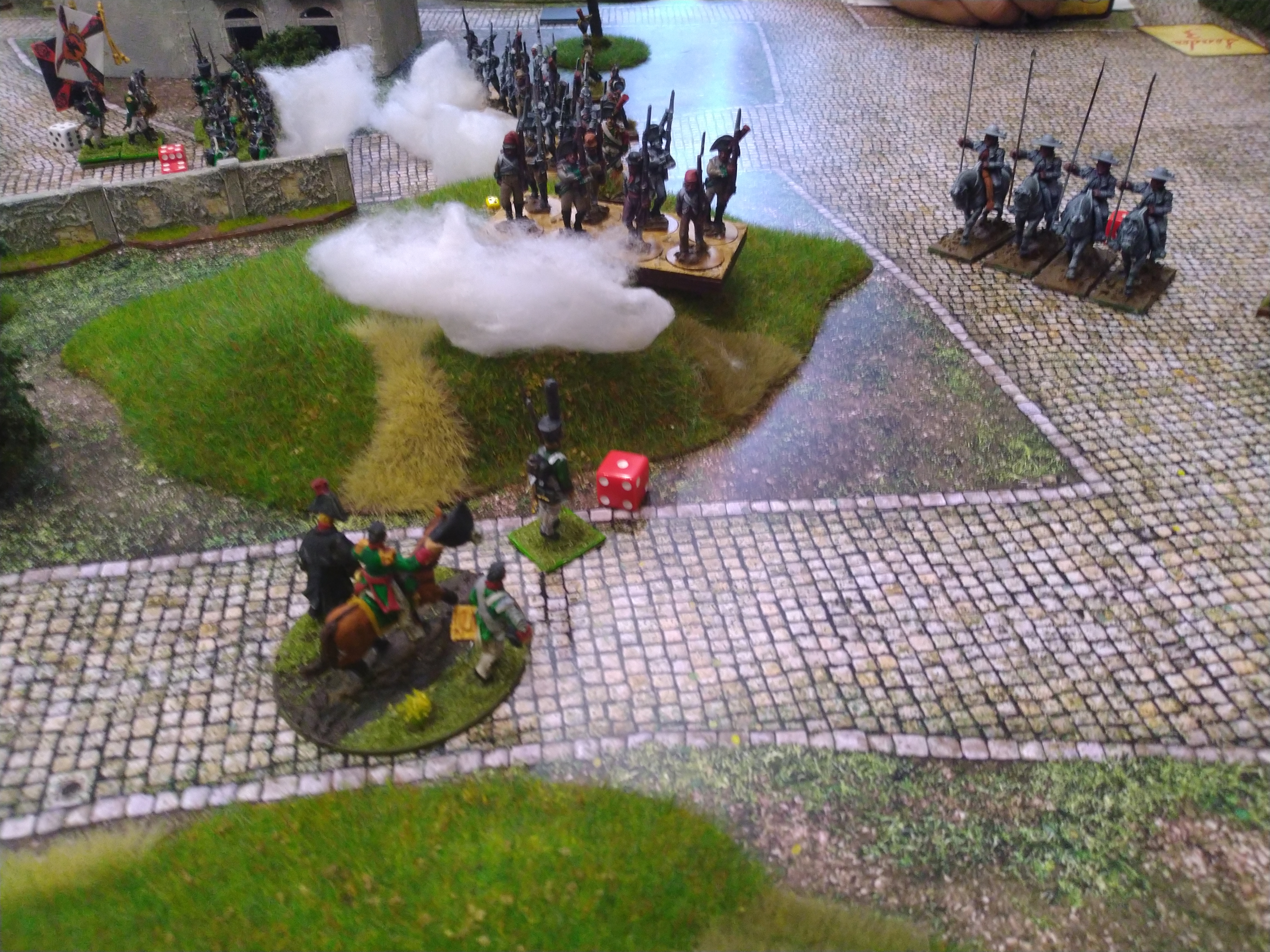
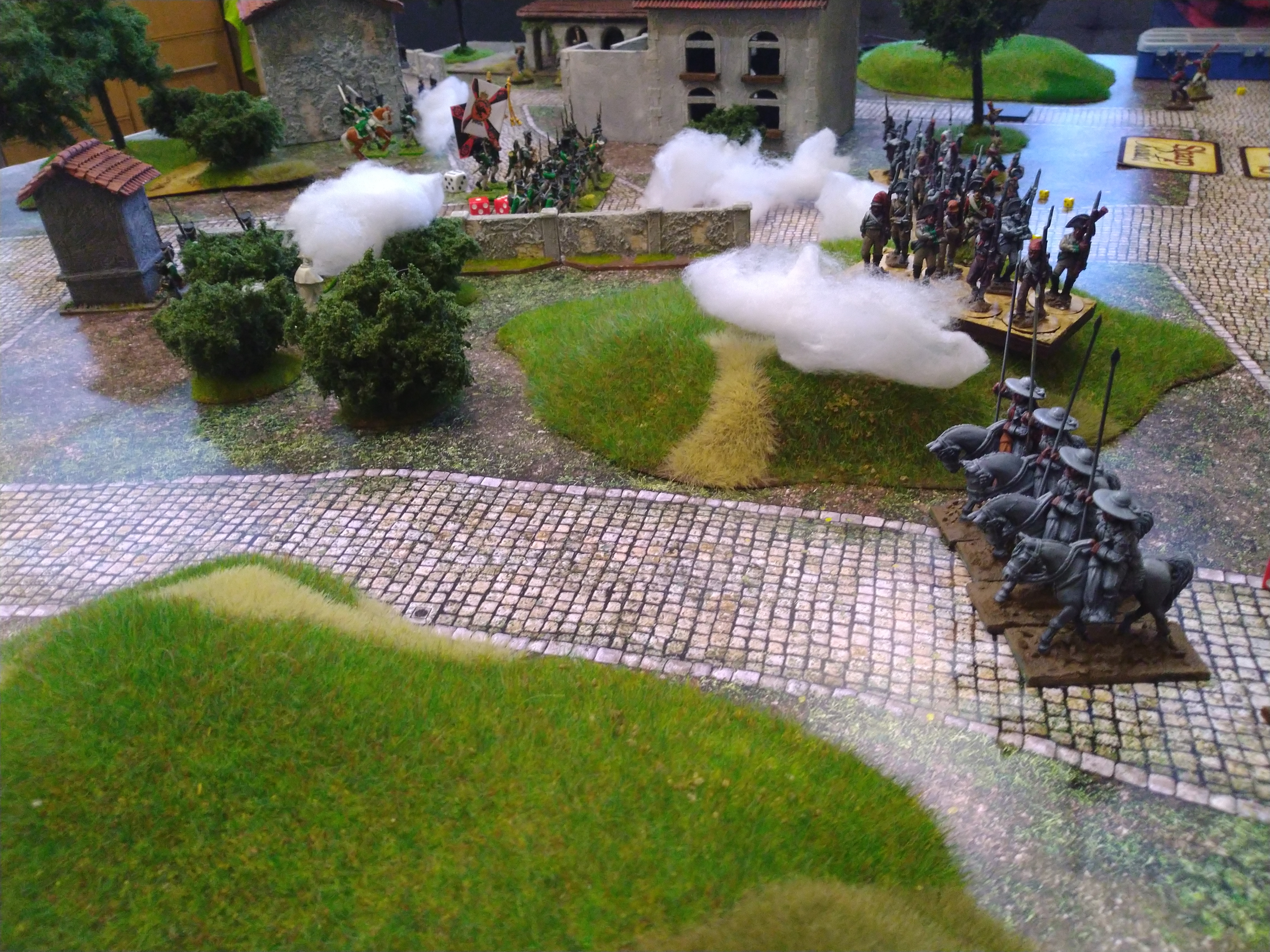
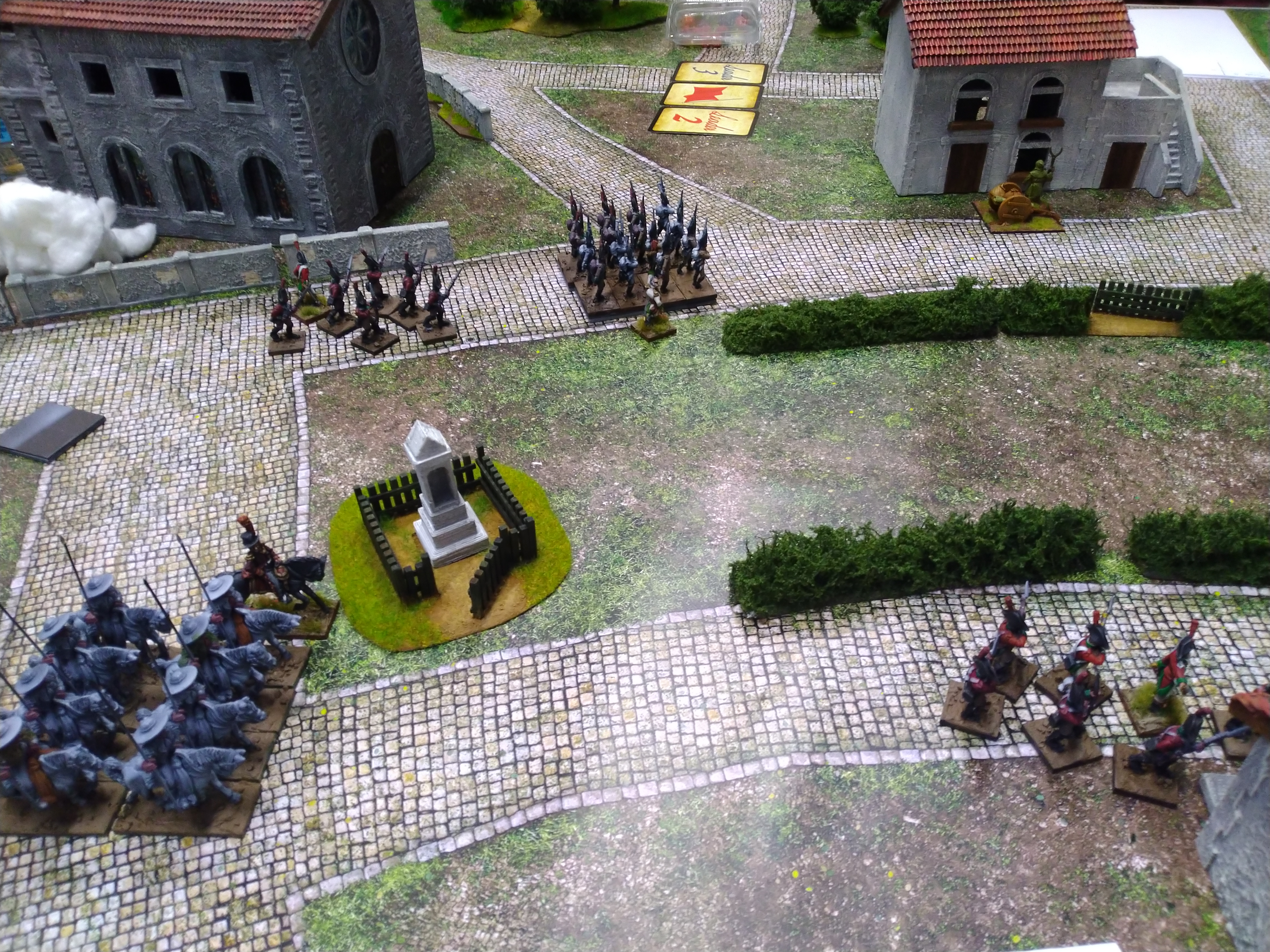
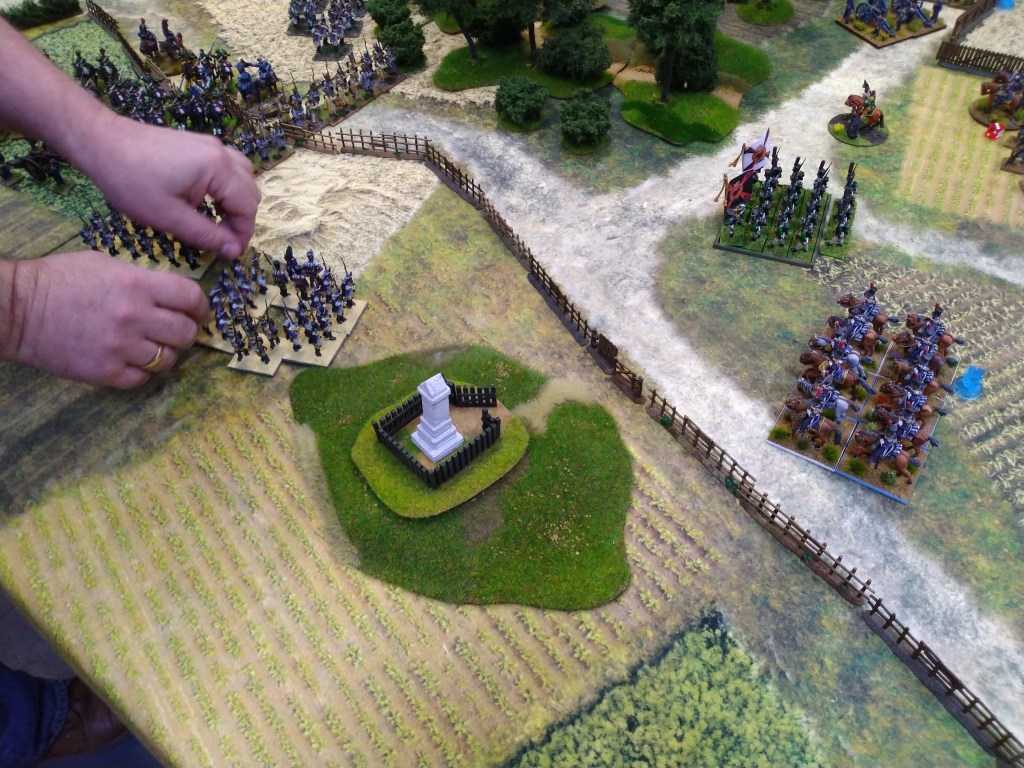
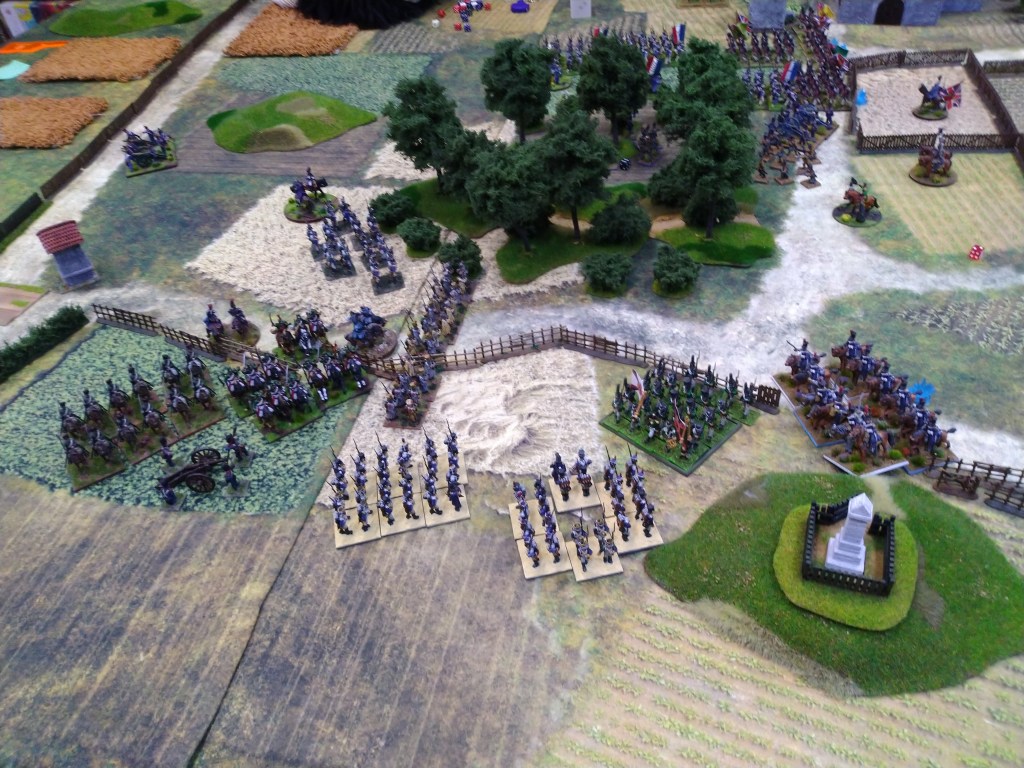
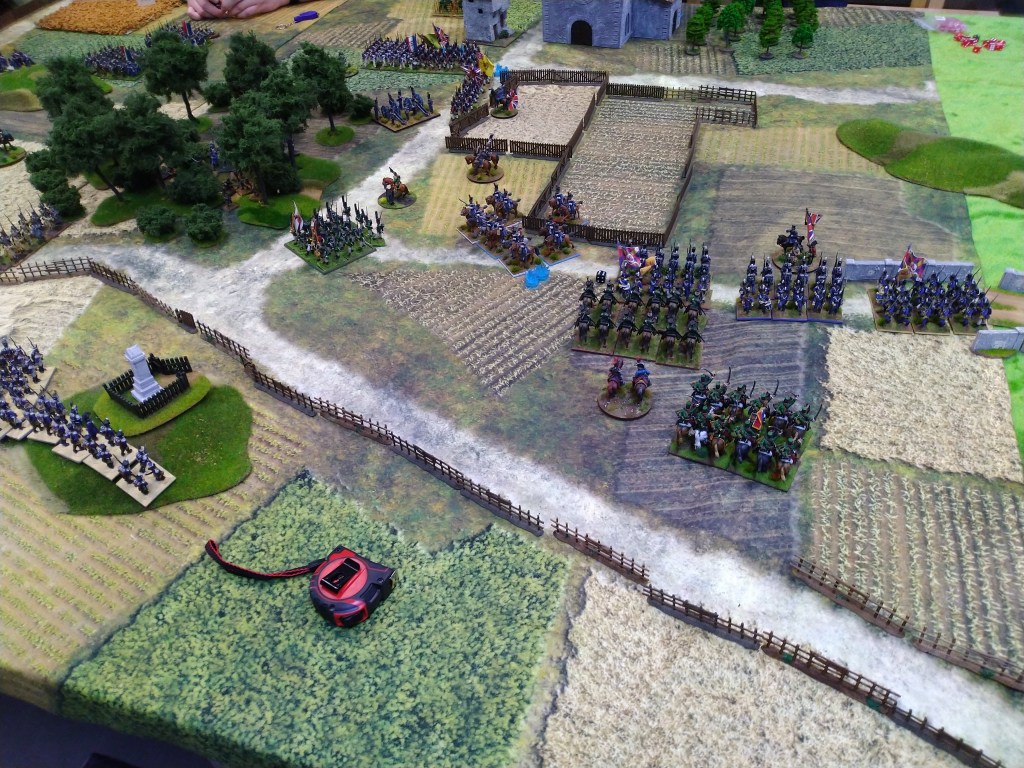
Saturday 29.05.2021 we played game with Marian, Jędrzej and me on one side (French, Polish, Russian) and Tomek and Damian on the British/Hannoverian side. Each side had six brigades. I assume that Tzar recognized Napoleon reign and splited Europe beetwen them – but there were still United Kingdom.
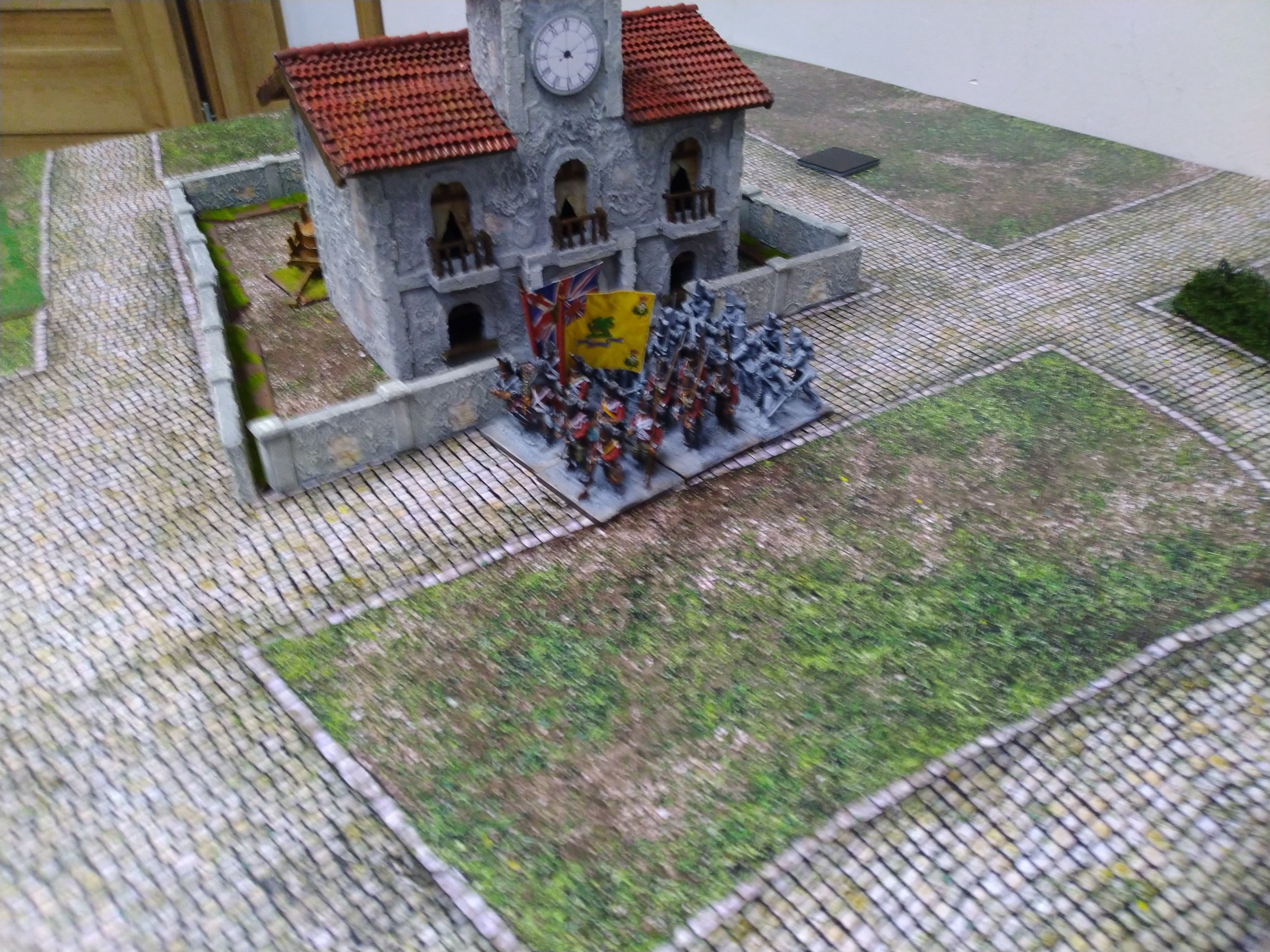
Sir Tomasz British arrived and turn in front of road inn.
sir Marians and Jędrzejs French, guards and cavalry.
Flank maneuver on right flank.
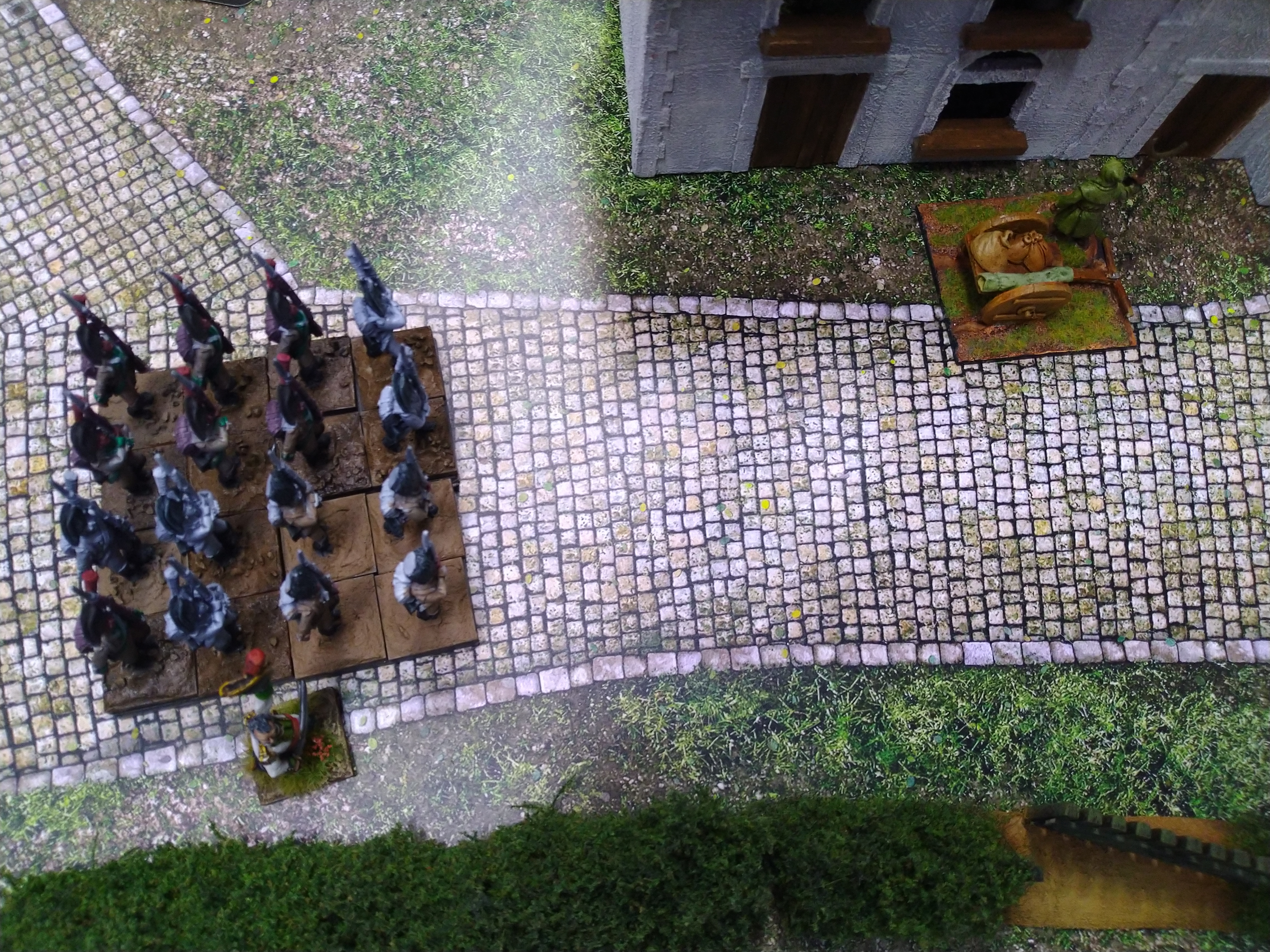
My Russians after hard drinking with French yesterday marched in long column forward. Don’t take care about incoming British (yes, I forgot that first I give order, then roll). It costed me high cost soon.
British cavalry charged and disabled my artillery, then moved back.
Maneuvers on right flank.
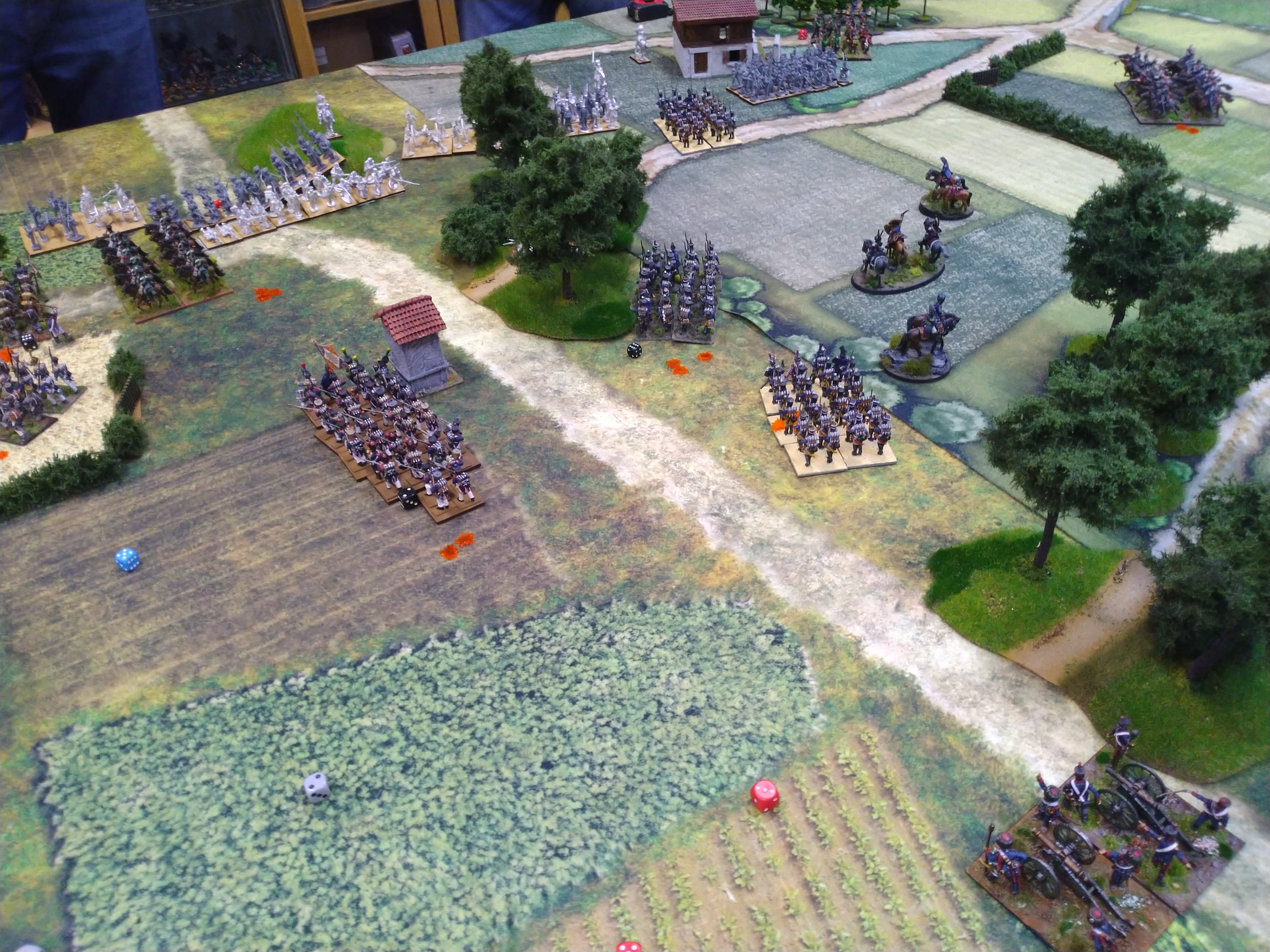
French columns went deep in the middle of battlefield.
Overall look from left flank.
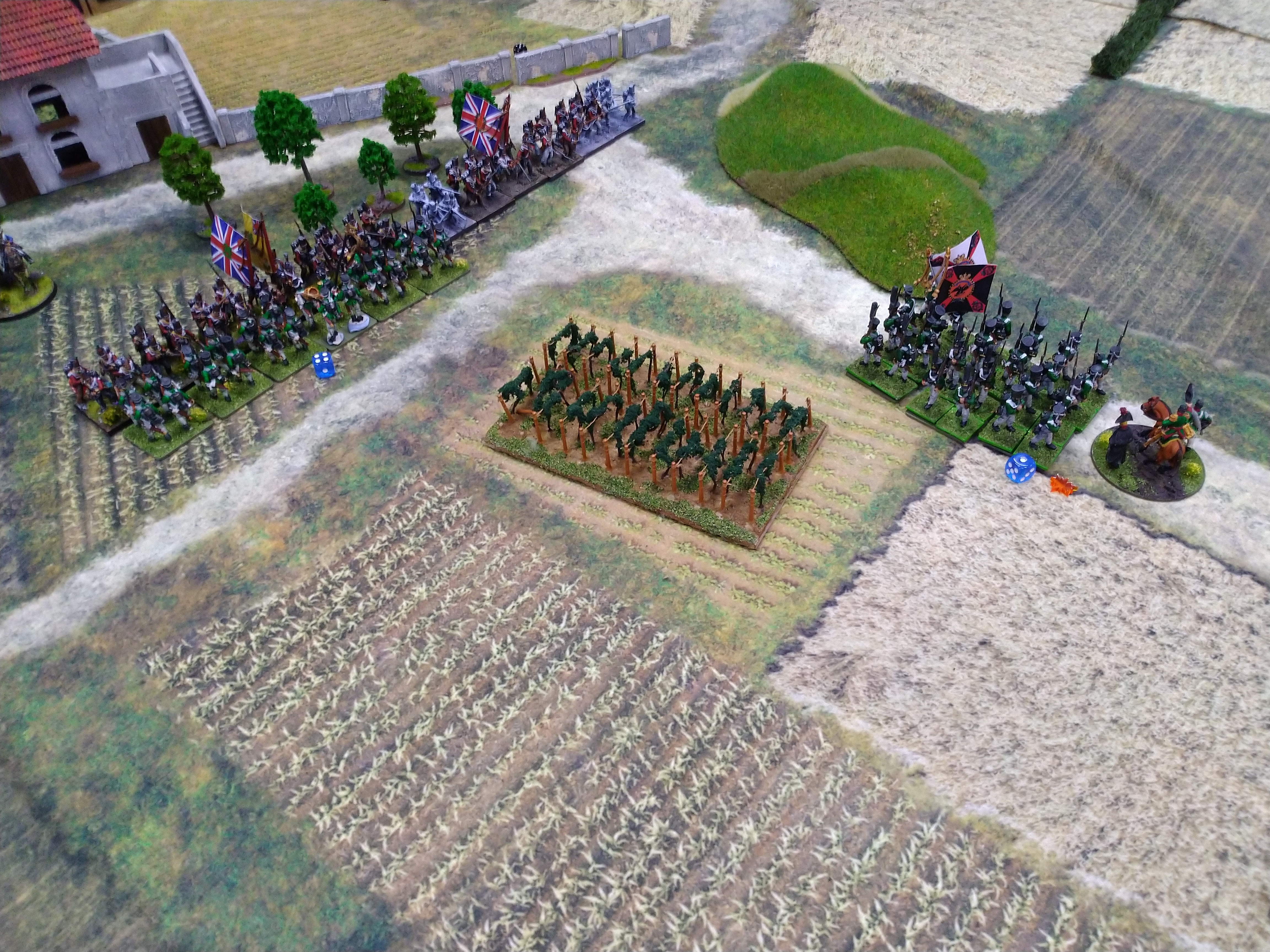
Russian 1st Batallion charged on British with bayonnets fixed on.
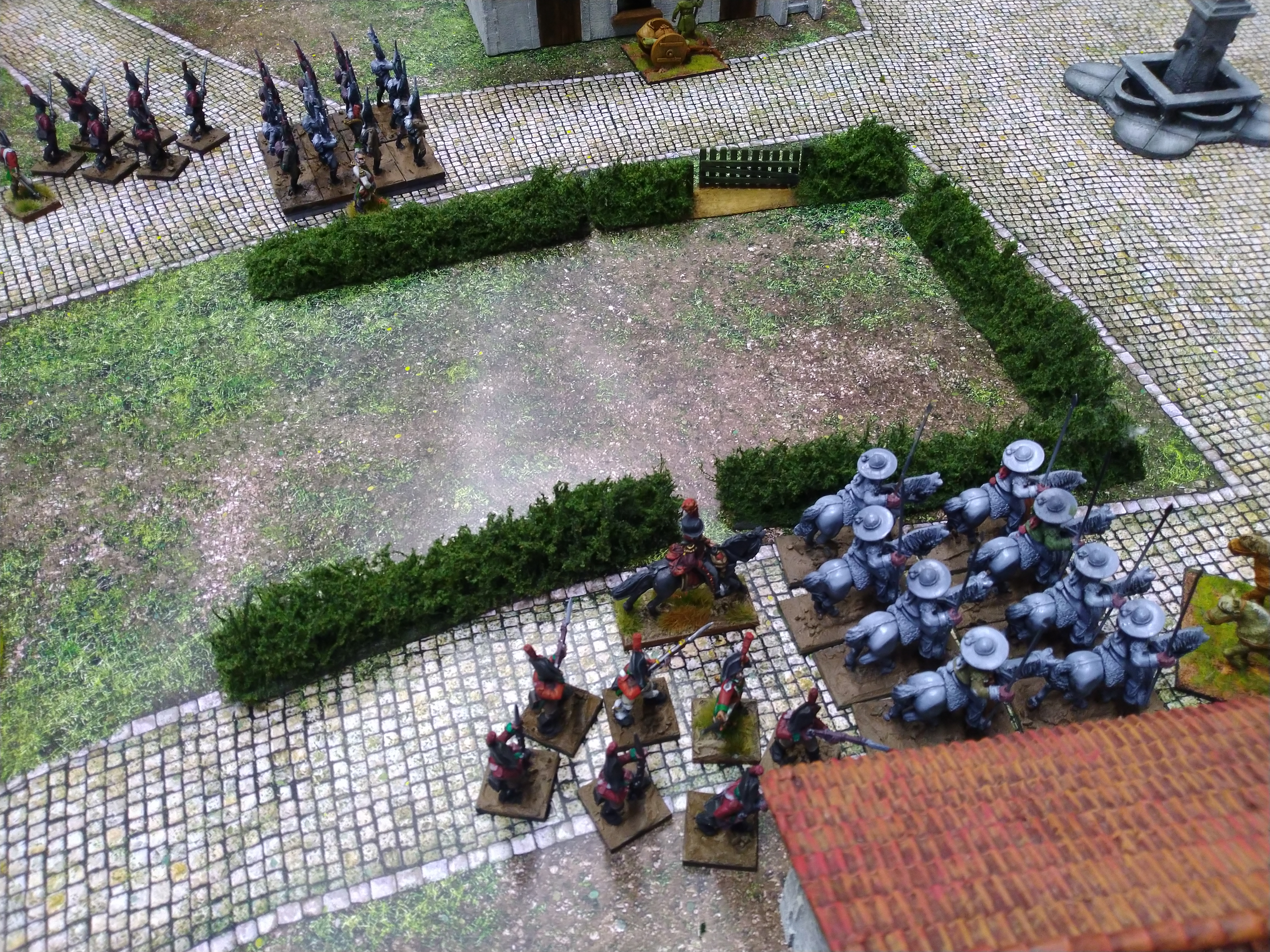
Right flank, where French heavy cavalry pursued some of sir Damians British.
1st Russian batallion ceased to exist, fleeing the field of battle.
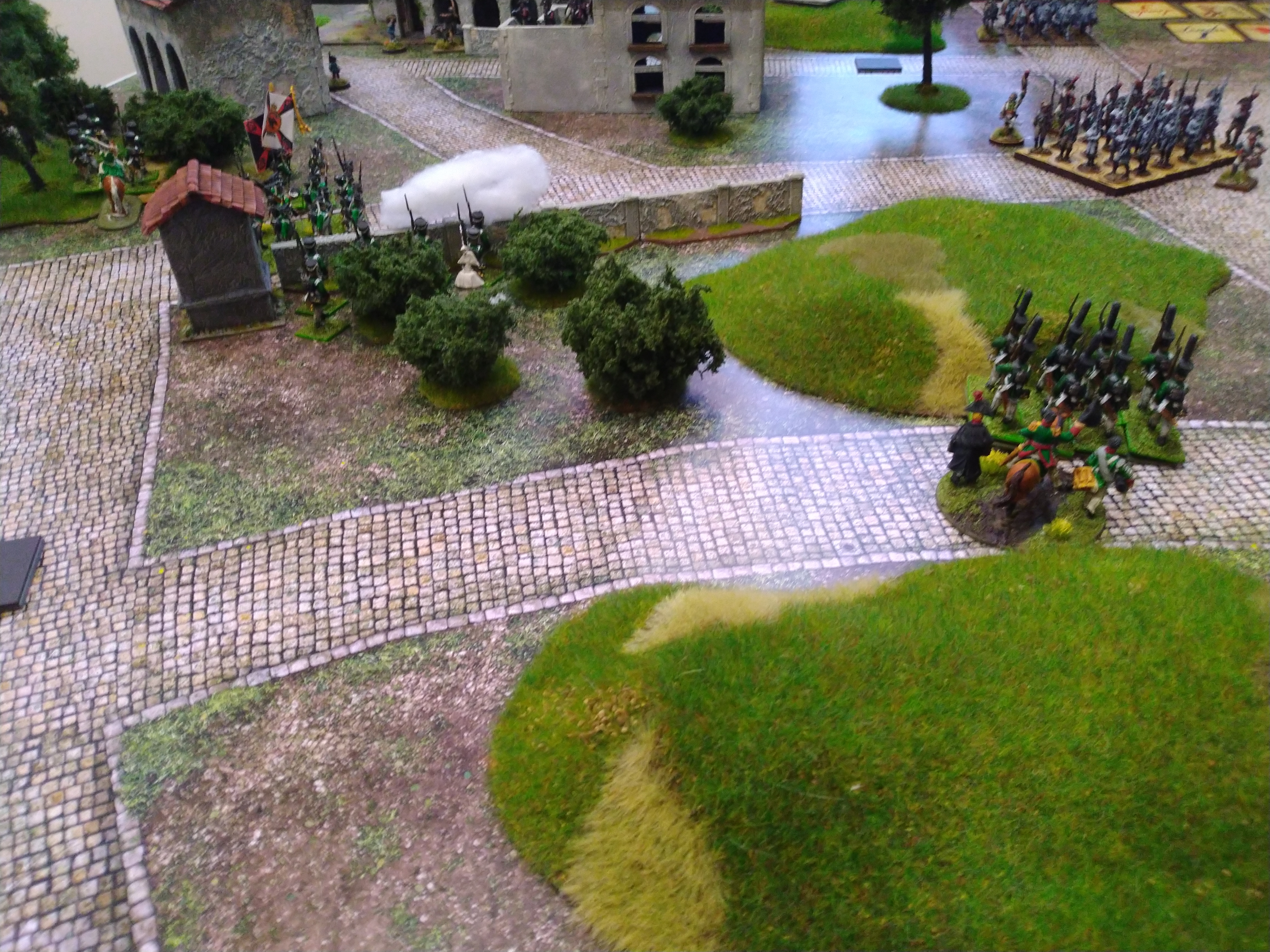
Russian-French brotherhood.
Vistula Legion charged on Damians infantry.
French and Russian on left flank try to clean field of Tomasz British.
If I’m correct, some of our units retreated on right flank.
2nd Russian battalion charged.
It was the end. At least my Russian brigade stand ground on the field and one more British fled field.
Summary: – nice game with many miniatures, need to finish my Russian brigade by adding one more batallion. – do not roll before giving unit order. – hope to have more painted soldiers next time, including maybe Russian uhlans.
Today with Rafał we played Sharp Practice game on 50 points in Bolter shop in Wrocław. My Russians were composed of line infantry with command group, group of grenadiers and two units of jagers. Rafał force was composed from line infantry, group of infantry, skirmishers and consript cavalry.
Russians came to the village.
In second card hand all Russians were on the table.
Jagers took positions in the cover. My behind wall, Rafałs in the building.
Hurry up grenadiers, outflank them!
Jagers started shooting at enemy skirmishers in the building.
Another Jager unit tries to outflank enemy…
…. at the end prepared to take out skirmishers in the building
Spaniards shot at grenadiers taking heavy toll – four of them felt from shooting.
On the other side Spaniards skirmishers were reduced to leader and rank and file trooper.
Fire, reload, fire reload. Grenadiers fixed they bayonnets. Line infantry as well fixed they bayonnets and runned in the front of Spanish infantry.
Spanish cavalry charged, but brave Ivan repelled them with bayonnet.
Both sides fought feriously – only Ivan survived from rank and file units.
Lone grenadier and half of cavalry moved back.
Ivan retreated with Spanish cavalry behind him.
After shoot Russian Jagers runned to the hill. The end – no one achieved enemy starting position.
Summary: – it’s really interesting skirmish game with interesting events which can happen sometimes. – rallying infantry after they start shooting sometimes is problematic – the man doesn’t wanted to listen to they officers. – Ivan was promoted to a sergant. – faith can reduce shock – shock is something like pin system in Bolt Action – unit with many shock points work less and less reliable. – many thanks to Rafał and Piotrek for great game and helping me finding appropriate priest model – need to work on him with some green stuff to made orthodox pop.
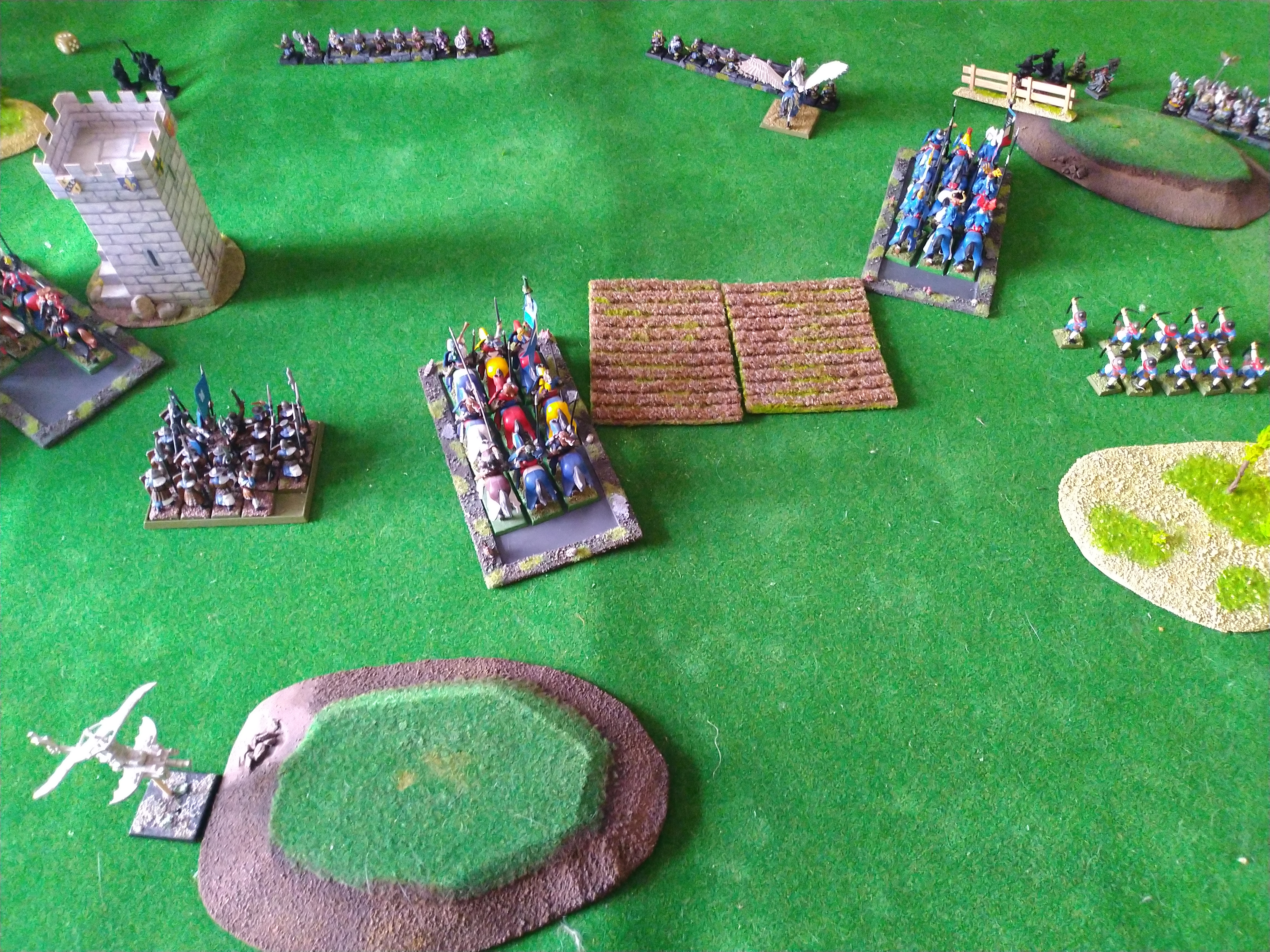
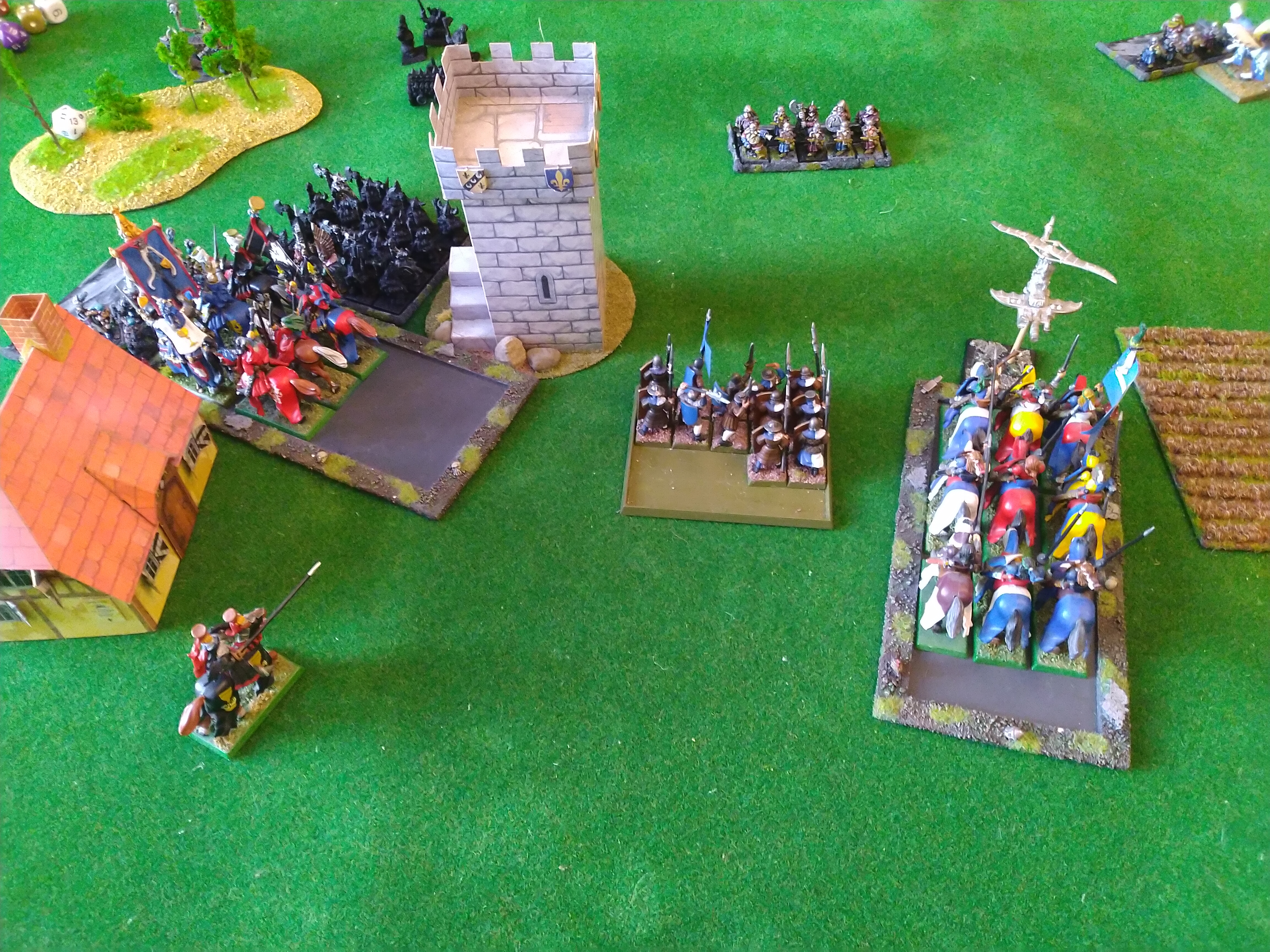
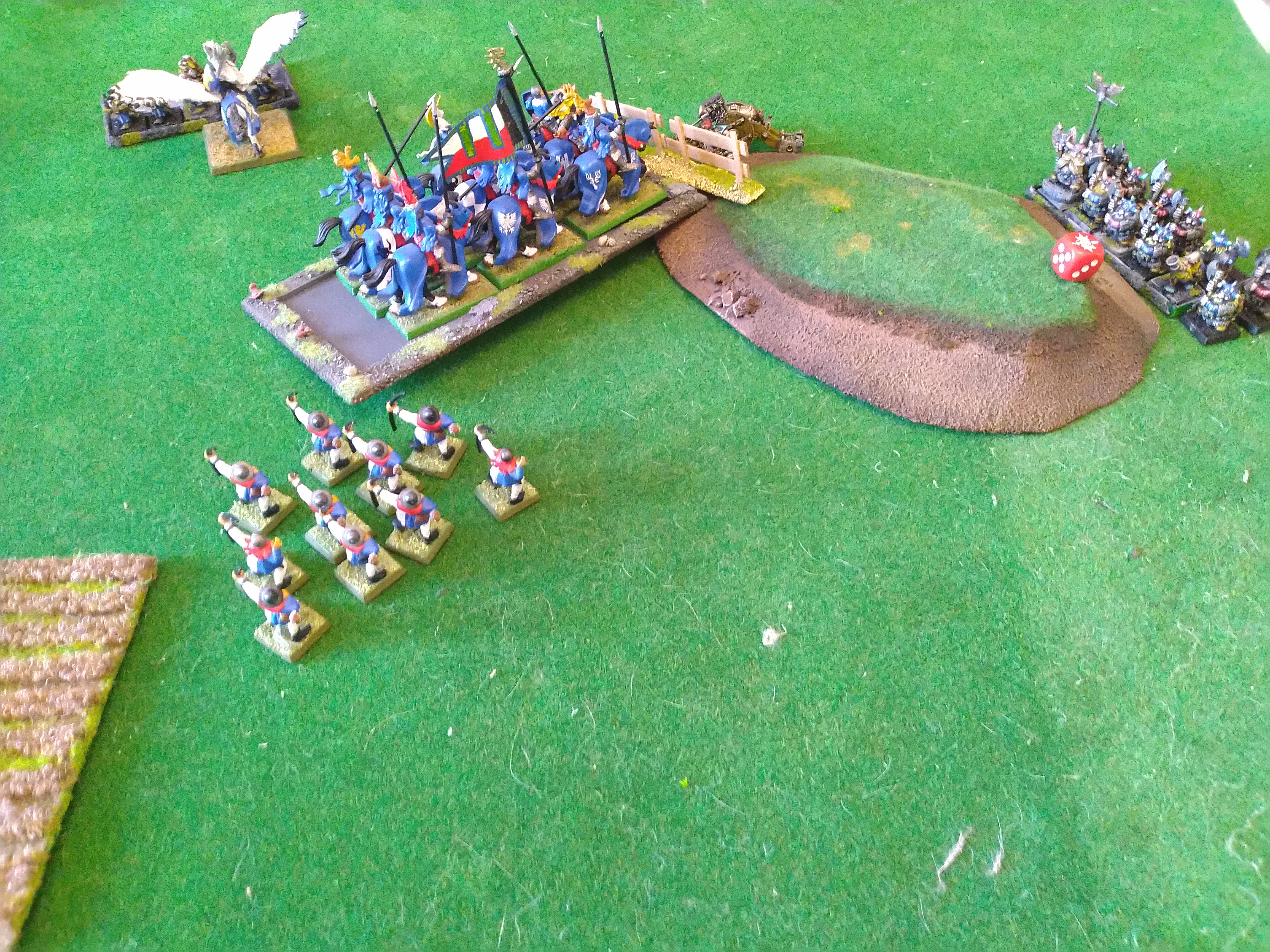
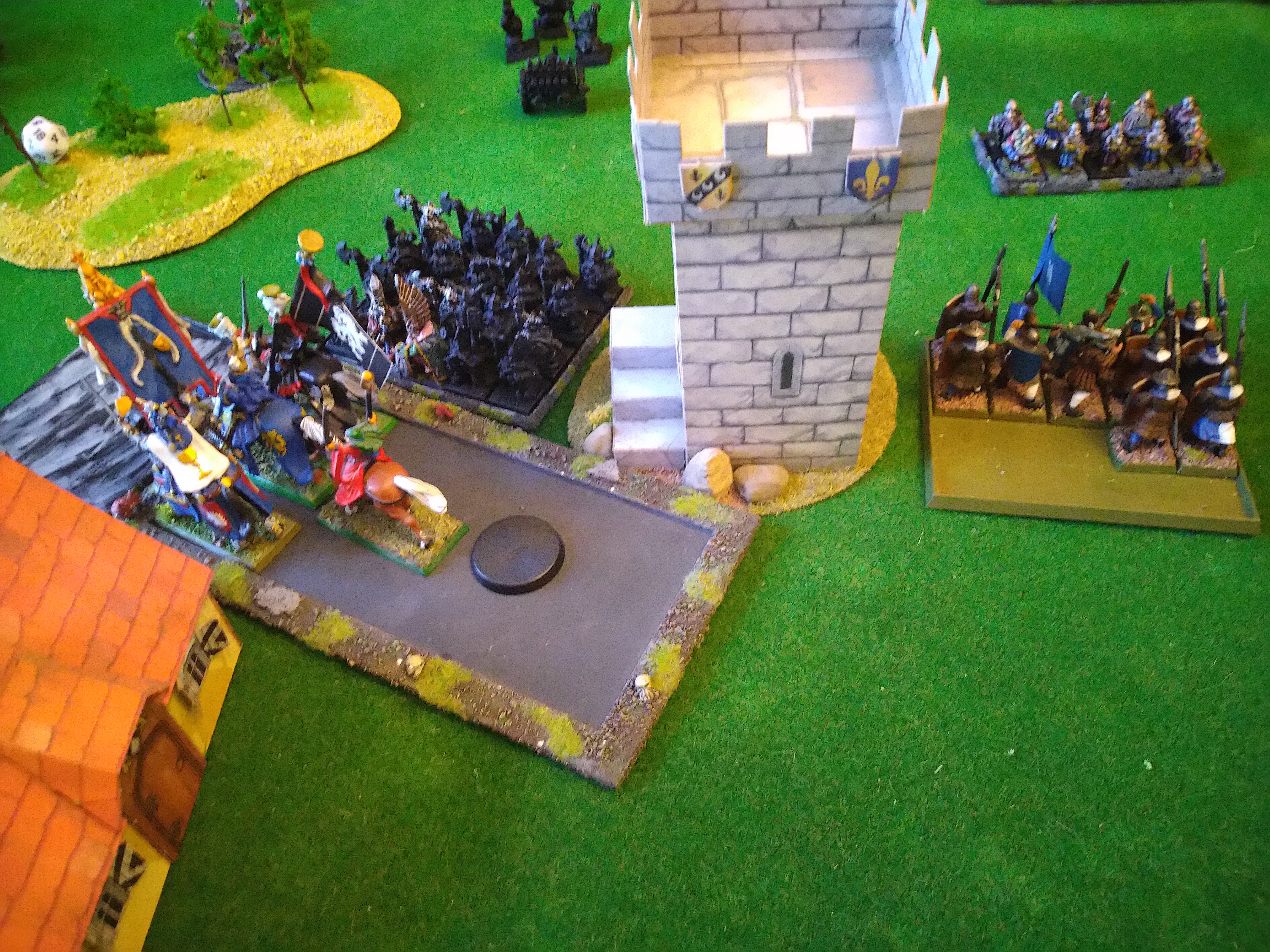
Today I played with Alessandro our first game in WFB 7th edition. It was interesting games with some rules used to make game playable for weaker armies like Beastmens.
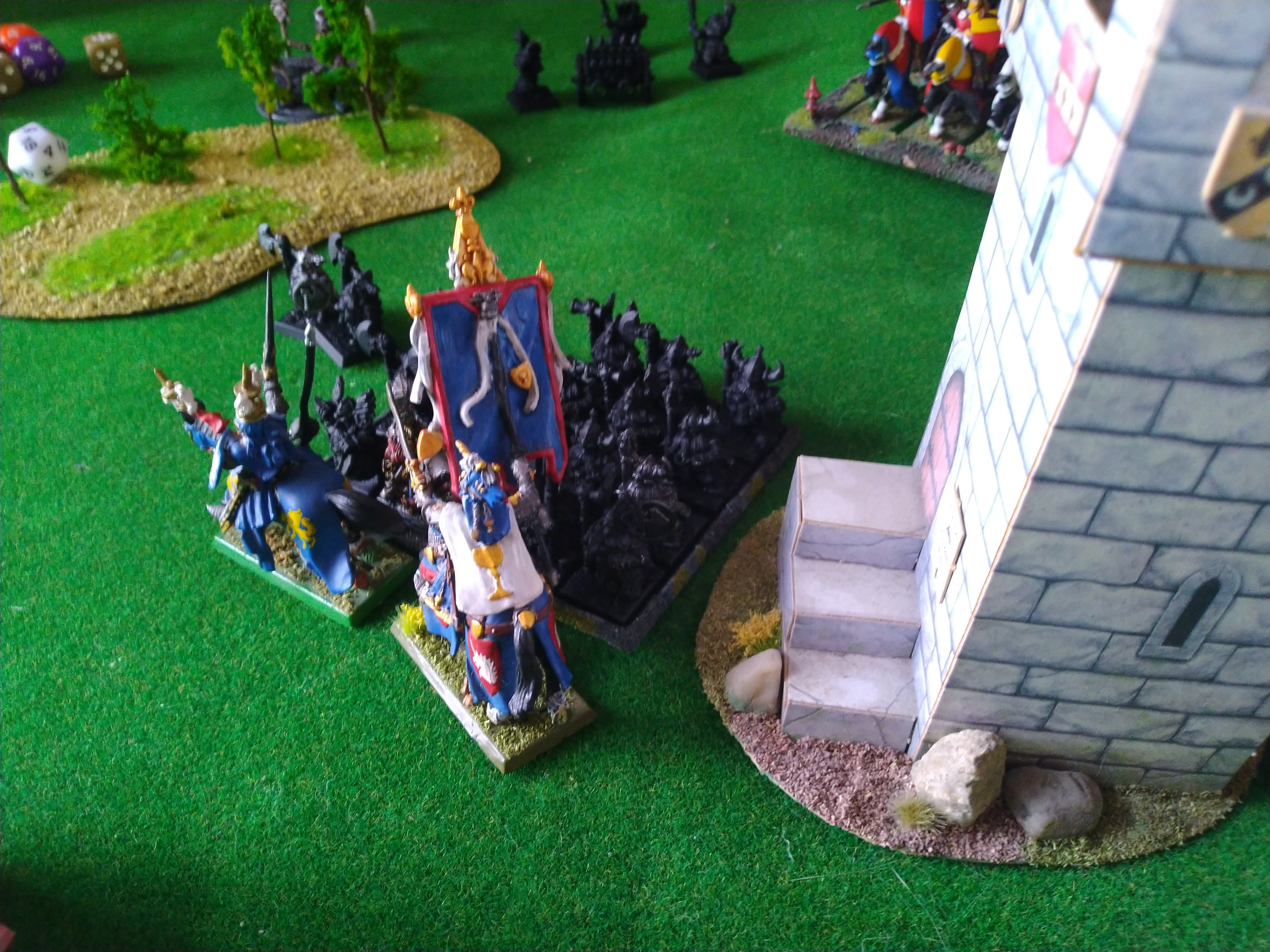
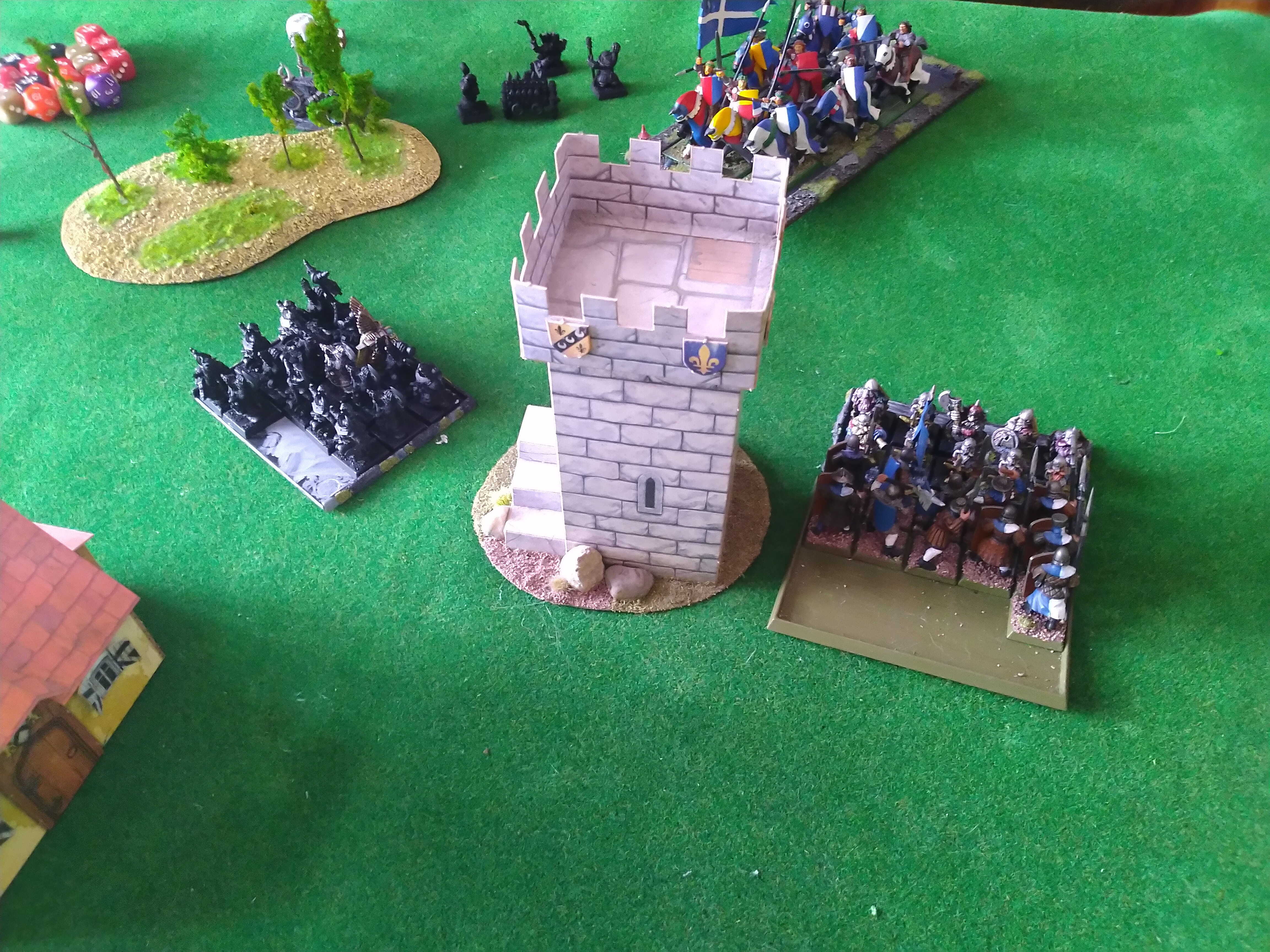
My Bretonnians.Alessandro Dwarfs.Bretonnian praying before the battle.Tragedy started at the beginning. Dwarfs probably drunk too much day before and one of they guns exploded (gun with re-rolls).Bretonnian advanced.Anvil of doom is dangerous, it was my first game against it and soon I losed Pegasus Knights from troll slayers.Coming closer, with Gyrocopter sending my archers off the table.Coming closer, hand to hand combat with gyrocopter.Stubborn cannon held knights for a while – never take cannon first.Knights Errants after pursuing gyrocopter tried to came back and help they Duc.Heavy combat beetwen Bretonnian Grail Knights and Dwarfs.Paladin on pegasus fighting with crossbowmen.Duc Tancred and battle standard fougt bravely, but were defeated.Brave Errant Knights were panicked by organ guns, but happilly rallied.The end. Bretonnian Duc rallied, army standard left field.
Summary: – victory belongs to Alessandro – I losed 1526 points of army and killed 604 points, I guess Dwarfs wone over me by massacre. – interesting play, wants to play again, first tabletop game in English I played (before I played board games in English). – first time meet Long Drong Slayer pirates who were playing as Troll Slayers. Now I think, that we should agree for use of mercenacy regiments and allies, as they can give more live to the Old World. – 2000 points formad need to be tested more with those rules, I got those rules from Davide on FB and translated to English from Italian. Maybe we will add something more and play them – test them.
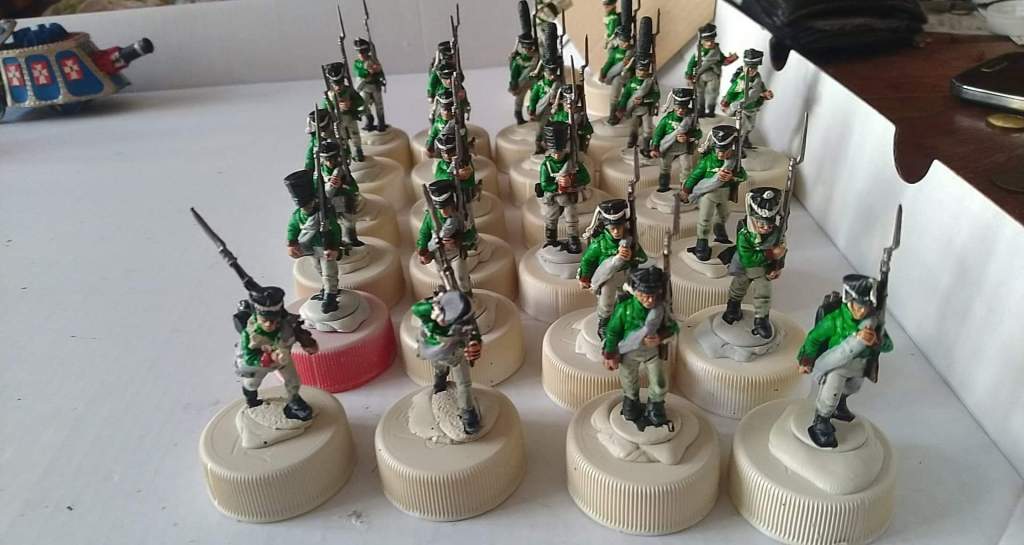
Today I finished second batalion of Brest Litovsk, Lithuania, Livonia and Smolensk inspections – at least I hope that such regiment existed – research before me, still guys are under Moscow banner. I have plan to create brigade composed of three batalions.
Models in unit are compositions of Warlord Games and Perrys Miniatures and they fit well. Paintes used there are mix of GW ordinary paints and shades plus contrasts (black, green and skin) – I will add list later to this post.
From today I know one more thing about cartridge boxes – I guess that in such big organization which was tzar army someone send them wrong ones 😀 .
Several years ago I bought on internet shop two Grail Knights, this weekend one of them joined ranks od my army. Still need to find appropriate decal sheet and create pennant.
There were loses, Agrax Earthshade was over desk, happilly only 1/3 of it.
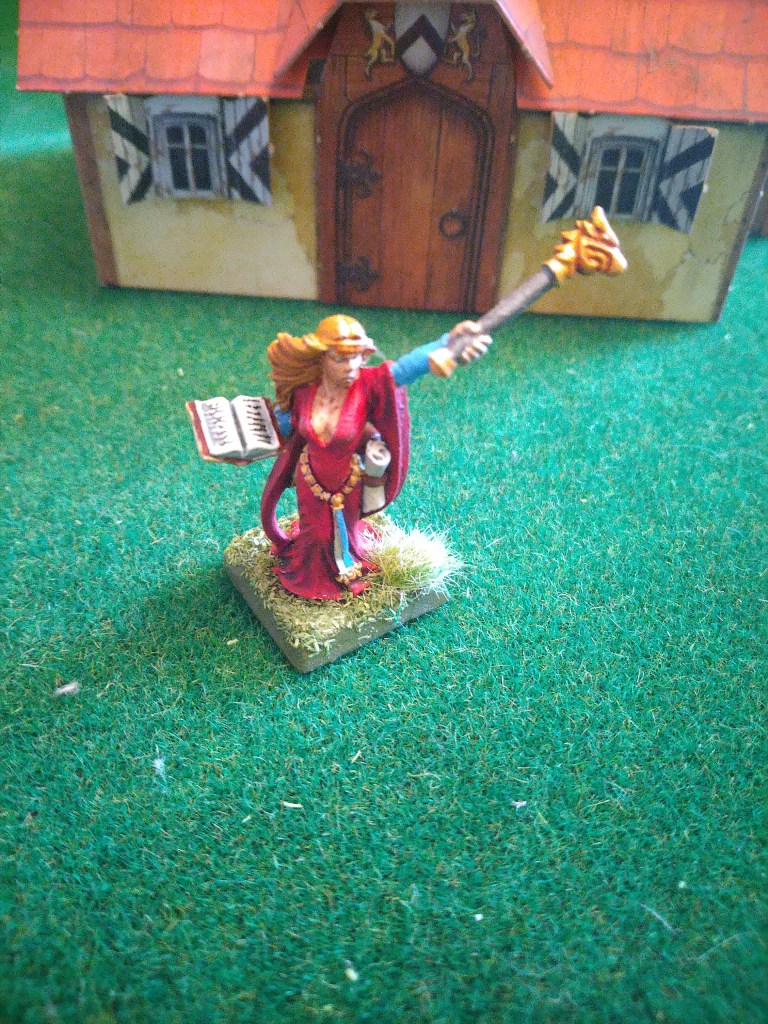
One more model finished – Bretonnian sorceress Caroline de Aques join ranks of Bretonnia or they allies Empire and Kislev (in time of need). Caroline speak well in Bretonnian and in Imperial Reikspiel. When she was young, her parent’s saw her magical talent. To avoid they daughter to be taken by the Fay Enchantress, they send her to magical school in Middenheim. After years of magical studies Caroline is ready to return to Bretonnia.
I bought this lady on internet shop, she lost her sword before I got her. Book, dispel scroll and bag are from Frostgrave set Wizards I bought with one of my friends year or two ago.
This Thursday I had a chance to practice Sharp Practice game from TooFatLardies. It’s Napoleonic skirmish game and as a skirmish uses less models than Black Powder game.
We played mission, where one side needs to find a spy who is hiding in one of three buildings and other side need to make other side life hard. Under eye of Rafał from Bolter.pl I played Spaniard against Tomasz British.
All Spanish troops came to a town.Marching forward to the city center.Casadores investigate first building. They leader unhappilly find attractive women.British marched in column around the townhouse and then……spread into deadly fire line.Both parties started firing each other. Some of the Kazadores also investigated if there is spy inside.Cavalry runned into the forest to outflank British.
Summary: – it’s interesting that there is Napoleonic skirmish, everything I recognize with that era, are large battles. – interesting system of unit activation – deck of cards is responsible for it, random events like officer stepping in the shit. Different personalities of leaders is also interesting. – system of morale decreasing. – need to try more, maybe with my own Russians – still need to paint them more to play Sharp Practice.
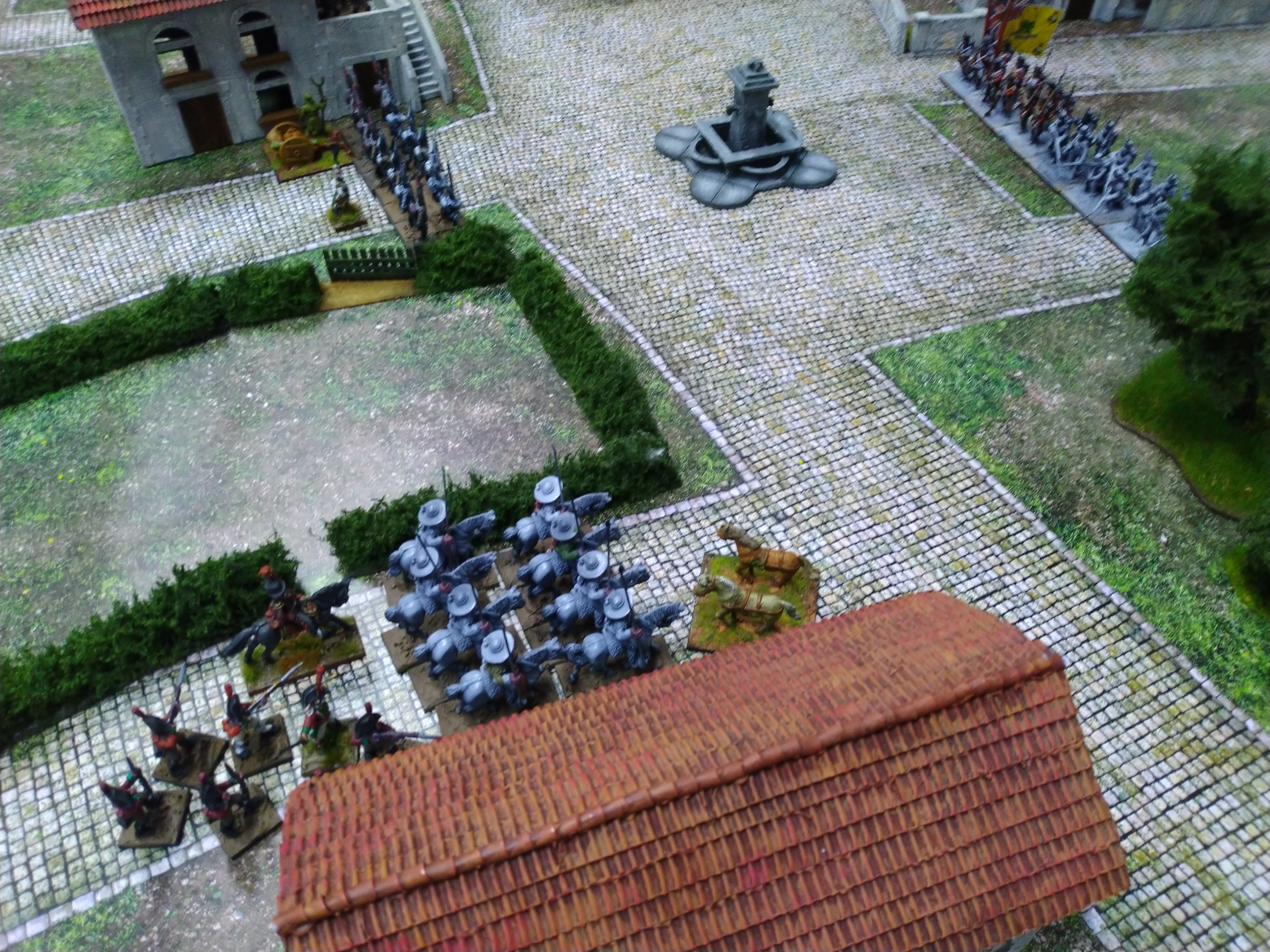
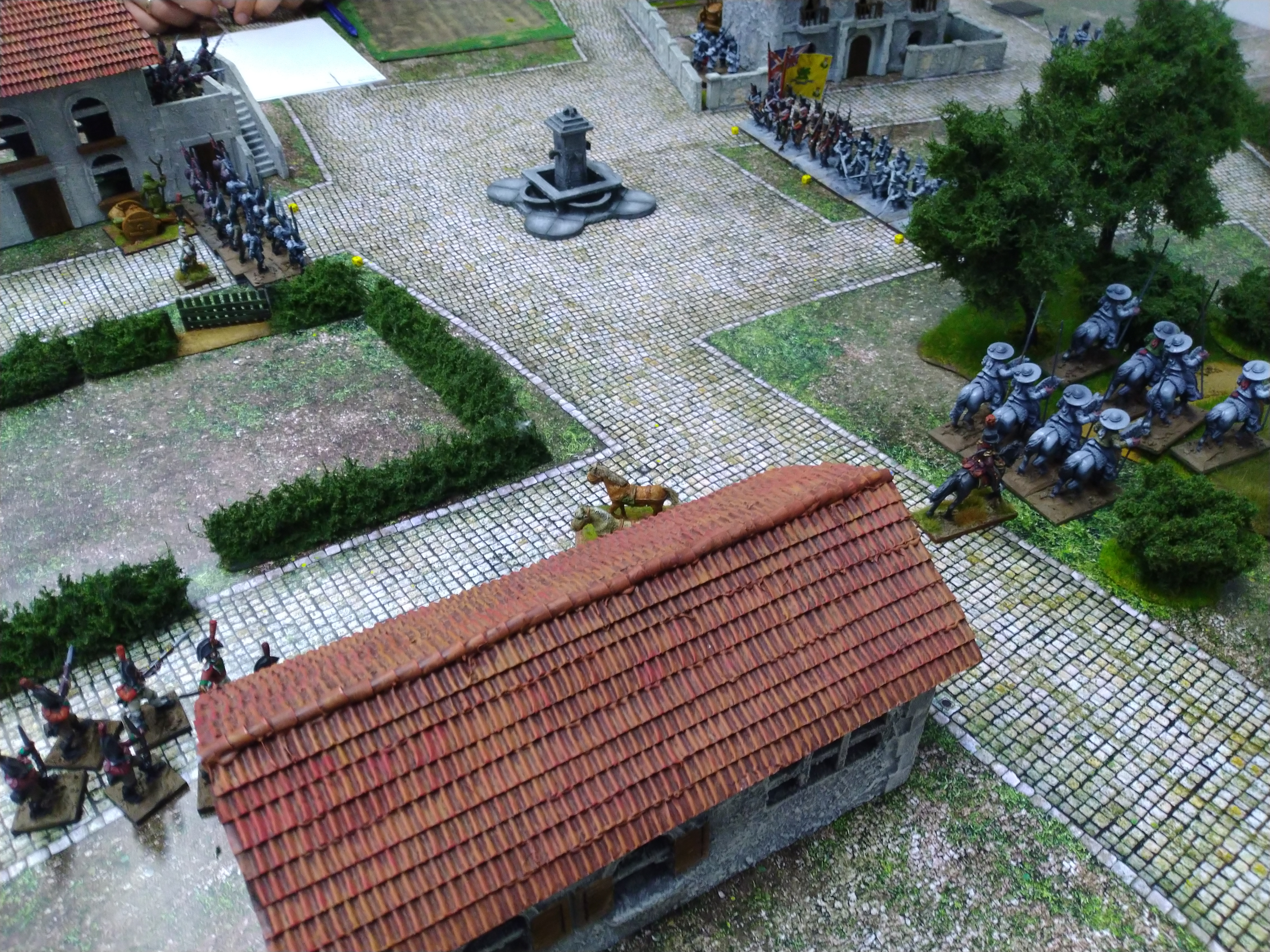
Today I played my first game in Black Powder and first game in Bolter shop. We played three on three in scenario when main object is to secure and held monastery. As I don’t have too many painted Russians I used borrowed models plus my only painted battalion with command group. It was interesting game. I played with Damian (Portuguese) and Rafał (British) vs Adam (Vistula Legion), Marian and Mikołaj (French).
Column of British, Portuguese and one Russian batallion.
Napoleonic French.
Main target – monastery.
French march toward monastery and British.
Russian batallion advance toward crossroads with supporting unit of cavalry. Near church French charged on bayonnetes. In the middle – light infantry tried to spread Chaos on French right flank. Skirmishing units were chased from forest in heavy hand to hand combat.
Portugal brigade stopped and did not moved for some time.
Cavalry charged and French infantry formed into quadrangle .
Heavy fight on right flank (near monastery), on left flank French heavily outnumbered they enemies.
Hard Russian infantry stood they ground, despite being outnumberd.
Finally Portuguese moved, but it was too late to change battle.
The End. French won, by breaking two of three our brigades.
Summary: – nice return to Napoleonic era. I guess it could be good idea to read about those times and units. – game written by Rick Priestley and Jerwish Johnson cannot be bad and is really nice, a little bit different to games I know. – shame on my, that my army is not painted with exception of commander, infantry batallion and two cannons. Need to finish some WFB and go back to Black Powder. – hopefully it’s not last game. We played this game in Wrocław, Lower Silesia – there is group on Facebook – Wrocławscy Bonapartyści. – my first game in Bolter, first game in Black Powder. List of nice places to play in Wrocław extended – as I like all time to play in Planszowka.pl (I returned to playing by ordering from them WFB/Bolt Action before AoS started) and in Aga and Ada, I hope to return to Bolter, at least to play and learn Black Powder.
1. Edycja piąta WFB była w pewnym sensie poprawioną edycją czwartą. Podstawowy zestaw zawierający podręcznik główny (Rulebook). księgę bitwy (Battle Book), dwie armie które w tej edycji dostały podręczniki: staroświatową Bretonnię (Bretonnia) i Jaszczuroludzi (Lizardmen) rodem z dusznych dżungli Lustri czy Południowych Ziem oraz linijki, kości, kartonowe budynki: wieżę, domostwo i stajnię. W przypadku Bretonni – byli już w podręczniku do czwartej edycji, ale nie otrzymali własnej księgi armii (Army Book). W piątej edycji Bretonnia przeszła znaczną metamorfozę, z armii która wyposażeniem przypominała w poprzedniej edycji Imperium przekształciła się w armię rycerzy wspieranych przez zbrojnych plebejskiego pochodzenia. Jaszczuroludzi historii nie pamiętam, wcześniej fluff wspominał o Slannach – potężnych istotach wędrujących między wymiarami, którzy w piątej edycji zostali faktycznymi przywódcami armii Jaszczuroludzi. W poprzedniej edycji zestaw podstawowy z podręcznikami zawierał Wysokie Elfy (High Elves) oraz gobliny (Orcs & Goblins).
W piątej edycji wiele armii do końca korzystało z podręczników armijnych z czwartej edycji: – Imperium (The Empire), Krasnoludy (Dwarfs), Leśne Elfy (Wood Elves), Mroczne Elfy (Dark Elves), Chaos Dwarfs (Krasnoludy Chaosu), Skaveny (Skavens), Orki i Gobliny (Orcs & Goblins). W piątej edycji następujące armie otrzymały podręczniki: – Bretonnia, Jaszczuroludzie, Dogs of War (najemnicy, w znacznej części z Tilei, ale nie tylko), Wampiry ( Vampire Counts – księga armii zastąpiła dotychczasową księgę Undead, dodatkowo w WD wyszły Tomb Kings – Królowie Grobowców), Wysokie Elfy (High Elves – otrzymały nowy podręcznik), Czempioni Chaosu i Królestw Chaosu (Champions of Chaos and Realm of Chaos – otrzymali nowy podręcznik w miejsce poprzedniej – Chaos).
Dla pewnych armii była to ostatnia edycja w której miały grywalny podręcznik np. Chaos Dwarfs i Dogs of War.
2. Skoro wspomniałem o Księgach Armii, zostanę przy tym co jest związane z armiami. Wielu z nas zapewne wie, jak wyglądało to w edycji 6, w której był sztywny podział na postacie (Characters) i jednostki (Units) np. lord (np. elektor czy wielki mistrz), lord czarodziej (wizard lord), kapitan (captain), czarodziej (wizard) i oddziały podstawowe (Core), wyjątkowe (Special) i rzadkie (Rare). W edycji piątej nie było czegoś takiego, za to był podział procentowy zwany Selekcją Armii (Army Selection). Dla przykładu użyję selekcji którą posiada armia Imperium: Postacie (Characters) 0-50% – lord (jeden i tylko jeden), bohaterowie (hero), czampioni oddziałów (champion), chorąży armijny (battle standard bearer), ujeżdżone potwory (ridden monsters) i wszyscy czarodzieje (wizards) byli w tej puli. Regimenty (Regiments) 25%+ – każdy oddział w armii był w tej puli. Maszyny bojowe (War Machines) 0-25% – działa, moździerze, czołg parowy i każda inna maszyna. Monsters (potwory) 0-25% – wszystkie potwory bez jeźdźca. Imperium mogło wziąć np. smoka. Sojusznicy (Allies) 0-25% – Bretończycy, Krasnoludy, najemnicy z Tilei, Wysokie Elfy i Leśne Elfy.
Tak więc mając 1000 punktów gracz mógł mieć w armii do 500 punktów postaci, przynajmniej 250 punktów w oddziałach, do 25% w maszynach, o ile nie wystawiał żadnych potworów czy sojuszników.
Oczywiście różne armie miały różne punkty procentowe w Selekcji Armii (np. Bretonnia mogła mieć do 75% postaci w składzie swojej armii).
Pierwszą ważną różnicą jest generał – armia zawsze miała generała z górnej półki i zawsze mógł być tylko jeden (w 6 na większe punkty można mieć np. dwóch wielkich mistrzów z których jeden był generałem), o ile w 6 edycji na tysiąc punktów generałem był bohater czy czarodziej (bo lord był nie dostępny), to w edycji piątej generałem zawsze był lord (u Imperium zwany General of Empire – jego statystyki w 6 edycji odziedziczył Wielki Mistrz). Kolejną różnicą był czempion – w piątej edycji czempion liczy się do puli postaci i może być wyposażony w jeden magiczny przedmiot. Bohater może mieć dwa przedmioty i Lord trzy. Można było mieć tylko jednego chorążego armii, który posiadał statystyki czempiona i mógł wziąć jeden magiczny przedmiot, który mógł być magicznym sztandarem. Było czterech różnych czarodziei – czarodziej (Wizard), czarodziej czempion (Wizard Champion), czarodziej mistrz (Master Wizard) i czarodziej lord (Wizard Lord). Ilość przedmiotów była uzależniona od poziomu – czarodziej mógł mieć jeden przedmiot i czarodziej lord cztery. Czarodziej ostatniego stopnia był też całkiem niezłym wojownikiem względem swojego odpowiednika z następnej edycji.
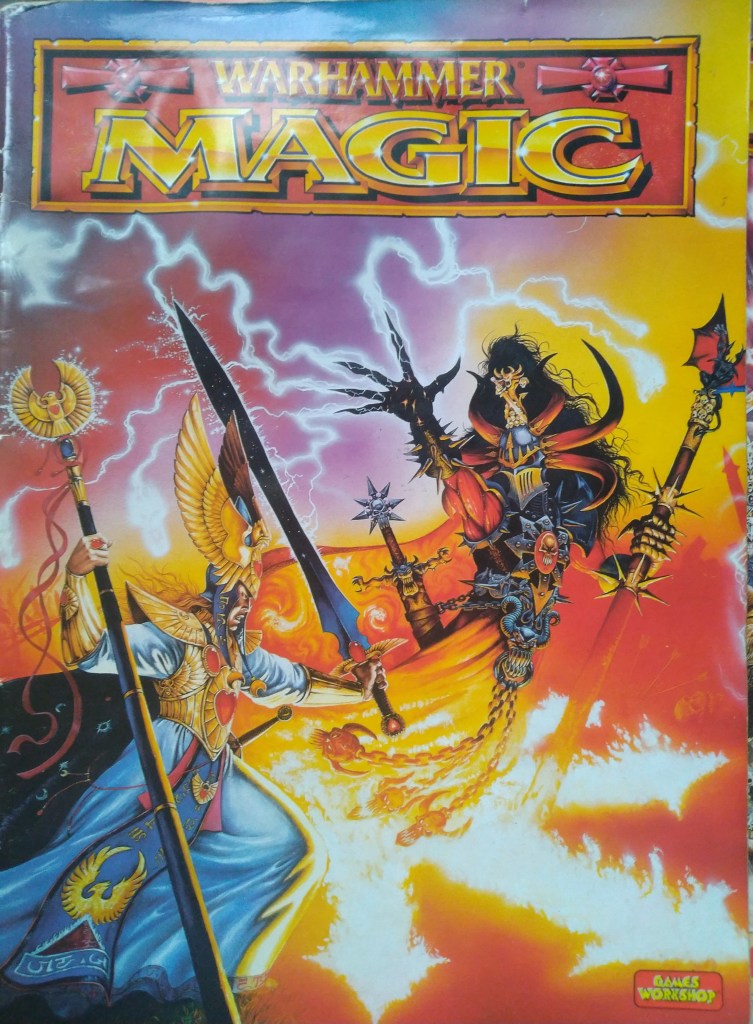
3. Mogę jasno powiedzieć – Magia kompletnie różniła się między edycją 5 a 6 i kolejnymi. By móc czarować należało nabyć dodatek autorstwa Ricka Priestleya o nazwie „Warhammer – Magic” (ewentualnie grać z kimś, kto owy dodatek posiadał). Książka dostępna była wyłącznie w pudełku z wszystkimi akcesoriami potrzebnymi dla czarodziejów żyjących w świecie Warhammera. W skład dodatku wchodziły karty dla każdego magicznego przedmiotu z księgi magii, efekty czarów, skaveńskie warp tokeny, a przede wszystkim najważniejsze – talie kart czarów (spell decks) oraz karty Wiatrów Magii (Winds of Magic). Następujące talie kart czarów zostały wydane: Magia Bitewna – Battle Magic, Magia zielonych – Waaagh! Magic, Magia Skavenów – Skaven Magic, Wysoka Magia – High Magic, Mroczna Magia – Dark Magic, Magia Nekromancka – Necromantic Magic, Magia Krasnoludów Chaosu – Chaos Dwarf Magic. W samej księdze magii było jeszcze więcej czarów, bo była tam magia Kisleva – Ice Magic, czary ośmiu Imperialnych kolegiów magii i czary trzech złowrogich potęg Chaosu – talie kart Chaos otrzymał później w dodatku Królestwa Chaosu (Realm of Chaos).
Czary były losowane przed grą z talii kart dostępnej dla danego czarodzieja np. czarodziej Wysokich Elfów musiał się zdecydować czy losować czary z talii Magii Bitewnej czy Wysokiej. Kart Wiatrów Magii było 36 sztuk – czym one były? Zniknęły w edycji 6 i już nigdy nie wróciły, zastąpione kośćmi d6. Karty Wiatrów Magii odpowiadały w edycji 5 za magię. Na początku swojej tury magii gracz rzucał 2k6 po czym wyciągał na przemian odpowiednią liczbę kart wiatrów magii – jedna karta dla siebie, jedna dla przeciwnika, jedna karta dla siebie itd. do wybrania z talii odpowiedniej liczby kart.
Faza magii wyglądała następująco: 1. Czar rzucony przez gracza do którego należała faza magii. 2. Przeciwnik próbuje kontrować lub nie czar z kartą wiatru magii Dispel lub np. Dispell Scroll. 3. Rzucający czar może wzmocnić czar. 4. Czar się udaje lub też nie. 5. Wróć do punktu pierwszego.
Następujące karty Wiatrów Magii znajdowały się w talii: 22 karty mocy (Power) do rzucania czarów lub wspierania rozpraszania, 1 Moc Totalna (Total Power) – czar rzucony w ten sposób był nie do zatrzymania, 8 rozproszeń (Dispel), 1 Pojedynek Umysłów (Mental Duel), 1 Zniszczenie Czaru (Destroy Spell) – specjalne rozproszenie mogące także zniszczyć czar, 1 Odbicie (Rebound) – specjalne rozproszenie mogące dać szansę na rzucenie własnego czaru, 1 Wyssanie Magii (Drain Magic) – wyssanie magii i zakończenie fazy magii, 1 Ucieczka (Escape) – czarodziej posiadający tą kartę mógł uciec śmierci w chwili gdy stracił ostatnią ranę.
W kolejnej części postaram się opisać różnice w zasadach między edycją 5 a 6. Moja kariera z WFB zaczęła się właśnie od edycji 5, dzięki artykułowi który ukazał się w Gamblerze w roku 1997′. Po pytaniu na WROhammer odnośnie różnic, postanowiłem przypomnieć sobie edycję w którą grałem w swojej młodości. To już około 24 lata tak WFB jak i trochę dłużej WFRP.
I hope that this text will be also released in English in the future.
Piąta edycja Rulebook i Battle Book.Podręcznik do Magii.Talie Wiatrów Magii i czarów.
Yesterday night around 20 o’clock I realized that I need to finish some started soldiers for my Empire and Kislev army. I’m really good in starting new projects and leaving them to start another one, which is not good, as I have many almost finished models on my deck.
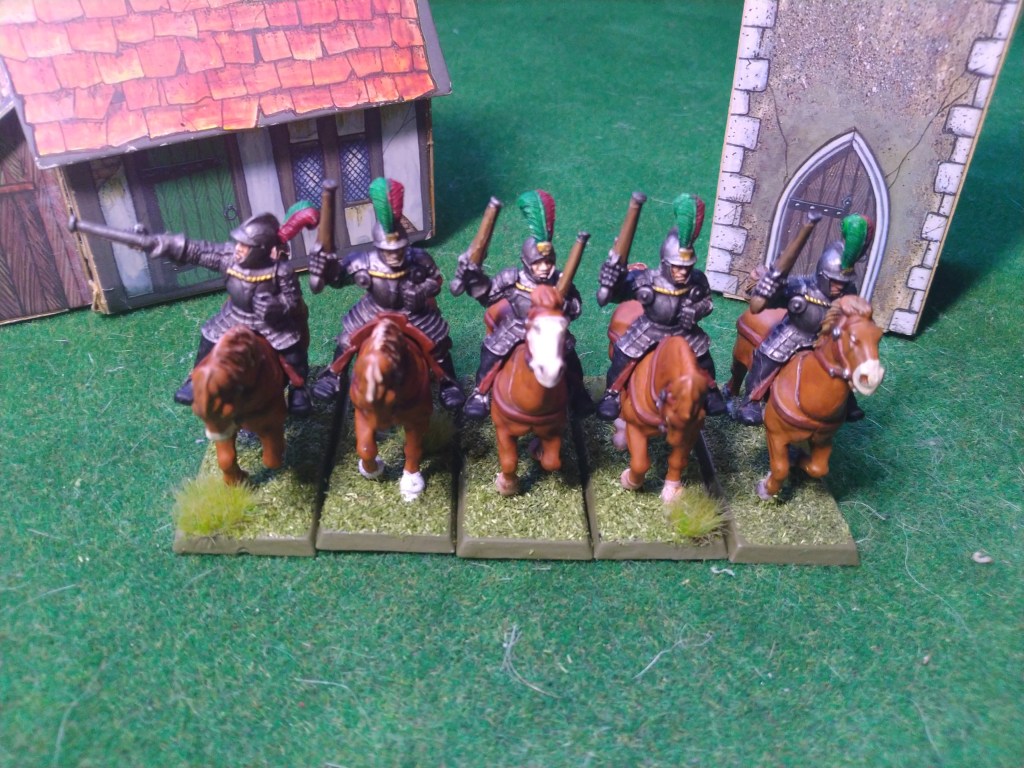
This time from thinking about it, I started painting pistoliers and they horses. Most of work I did up to the midnight, with some details today morning before starting work.
Four more Hochland pistoliers join single one I painted in past. Now I have valuable unit of Empire noble sons, ready to fight for they elector Adelbrand Ludenhof, for Emperor Karl Franz from Holswig-Shliestein family, in the name of Sigmar!

































 tancreddebeauville
 Tancred’s Tabletop Tales